Earlier today, I saw a post on Threads about a woman who was afraid she was about to be laid off at a meeting tomorrow. Everyone commenting on her post encouraged her to quickly gather anything on her computer that she would need for future interviews. It reminded me of some of the best advice I’ve been given. When I was a undergrad, one of my PR professors told us to “Always keep your resume and portfolio up to date.”1 Her rationale:
You never know when you will get an opportunity for an interview. Sometimes, even when you are not looking for a job, an unexpected opportunity might present itself. Be ready.
You never know when you will get laid off. PR firms and ad agencies have a tendency to reduce staff when they lose clients. Be prepared.
You will forget important details. Will you remember what projects you worked on? Volunteer work that you did? Don’t trust your memory.
It’s incredibly awkward to reach out to an old job to get samples for your portfolio. And if you didn’t leave on good terms, it may be impossible to get samples. Think ahead.
This advice has stuck with me for decades. When I was a designer and creative director, I updated my InDesign resume document, physical portfolio and online portfolio frequently, even though I changed jobs rarely. I was always ready, just in case the right opportunity came along.
Now that I’m mostly an academic, I keep my Curriculum Vitae (CV) up to date here on my personal website. In fact, I updated it last week after I presented at an academic conference. I like having my CV2 on my personal website. It’s basically the master document summarizing my career and experience, and it is easy for me to share a link with people immediately. I also try to keep a subset of my experience updated on my LinkedIn profile, even though I don’t spend a lot of time over there.
Anyway, I think it’s good advice for anyone to keep a resume or CV up-to-date, preferably on your own website. You just never know when you will need it. And I hope that women on Threads doesn’t get laid off.
Bob Wertz is a type designer, Ph.D. student and researcher living in Columbia, South Carolina. He’s been blogging since 2008.
I swear I’ve written about this before, but I can’t find it anywhere. ↩︎
A resume tends to be a short 1-2 page summary of work experience, while a CV includes pretty much everything and can be as long as it needs to be. My CV is a hybrid of a traditional CV and a resume. ↩︎
I attended a conference this week and one of the speakers spoke about the ethics of AI. He did so in way that I felt was very thoughtful and considered. I won’t attempt to summarize details of his whole talk, but one of the things he encouraged was to develop your own personal philosophy when it comes to AI. What uses are acceptable to you, and what lines will you not cross? Funny enough, I’d added a section to my “About Bob” page that essentially outlined my philosophy under the heading “What is your stance on AI?”:
I do not use large language models (LLMs) to write posts on bobwertz.com or any of my sites. I’m also strongly opposed to using generative AI imagery. I believe that LLMs were largely trained on creative materials without permission, and as such, they are remixing stolen intellectual property. Also, in general, AI imagery sucks. I’m an artist and I can draw it myself. I use an AI feature of Micro.Blog to add alt descriptions to my pictures. The computer is better at describing the image than I am, and I feel like having alt tags on my website is important. I also use the ChatGPT service my university provides to assist with simple coding and troubleshooting.
I’m happy with this as a start. For me, I’m hesitant to throw AI at everything, but I can’t deny that in some situations, AI is helpful. I’m concerned about the environmental impact, but I’m just as concerned about the intellectual property theft. As systems uses less resources and as new models are (hopefully) ethically trained, my opinions might shift. We’ll see…
Bob Wertz is a type designer, Ph.D. student and researcher living in Columbia, South Carolina. He’s been blogging since 2008.
In society and on social media, there are a lot of people drawing lines.
I know that I draw some lines…
I left Twitter because I felt like Elon Musk changed the service to something that didn’t align with my values.
I got rid of my 37 Signals/Basecamp books after DHH started sharing his view of the world.
I avoid Hobby Lobby like the plague.
I refuse to go to the Melting Pot in my city because it’s owned by my state representative who happens to be part of the S.C. Freedom Caucus and has supported problematic legislation.
I wouldn’t use Substack because I know they platform people with hateful ideologies.
I think prediction markets are scams.
I unfollow bullies on social media, even if I agree with them.
Other lines are more difficult to draw…
Joss Whedon created some of my favorite shows, but turned out to be a jerk. I still watch the shows, but I admittedly enjoy them less.
I read every book and watched every movie of the Harry Potter series. J.K. Rowling uses her immense wealth to fund transphobic causes. I likely won’t watch the new series.
I’m a lifelong Cubs fan, but I don’t love the politics of the current owners, the Rickets family. I still cheer on PCA and my Cubbies.
I’m critical of how data centers harm the environment and I avoid using generative AI for imagery, but I also see legitimate and timesaving uses for AI in my life.
Chick-Fil-A. It’s tasty. Especially for breakfast. But the late founder’s views don’t align with my views.
I use Threads, but I dislike Meta. I mostly stay away from Facebook and Instagram.
Sometimes, other people draw lines that include you…
I live in South Carolina, and I routinely see people hate on my home state for various political reasons. Some criticism is deserved. Some isn’t. But this is home and it’s not as red as you think. Especially not Columbia.
Some people hate Apple and ridicule their customers. I love my Apple devices, even if I know the company isn’t always on the side of the angels.
I work in higher ed and am a Ph.D. student. Some people hate universities right now. That’s okay, I used to work in insurance and the hate was much more intense.
I still shop at Target and Amazon.
I’m an ELCA Lutheran, which is one of the more liberal Protestant denominations. But as a Christian, I’m often lumped in with ultra conservative denominations who have totally different theology.
Sometimes, people get upset when other folks draw their lines differently. While I advocate for causes I believe in, I don’t get too hung up on where people draw their particular line. Boundaries shift over time. For me, I stay open minded to new viewpoints, and my lines change as new information becomes available. I hope others do the same as well.
Bob Wertz is a type designer, Ph.D. student and researcher living in Columbia, South Carolina. He’s been blogging since 2008.
When I was in high school in Aiken, South Carolina, in the early 1990s, I was in Walmart flipping through the discount CD bin.1 For some reason, maybe I was headed to a football game, I was wearing my “Hornet Hecklers” shirt… a bright yellow shirt with green lettering that all the Aiken High students wore in the student section. Randomly, this guy with a long white beard and overalls walked up to me and told me I was going to hell because of my shirt.
“Pride,” he told me, “will damn you to hell. Repent.”
I’ve never forgotten the experience. I never understood why this guy felt it necessary to confront a teenager he didn’t know in public. Theologically, I’m still not sure what about my shirt offended him. I’m sure he thought he was trying to “save my soul,” but he was really just a sanctimonious fanatic who wanted to demonstrate his perceived moral superiority. And teenage me was an easy target.
There are a lot of sanctimonious fanatics on the internet. People who rush to judge. To pile on. To bully. They believe that they can intimidate others into changing. They believe they can win whatever argument of the day they want to start. These keyboard jockeys are no different than the dude with the long beard and the overalls, convinced of their moral superiority and eager to demonstrate it.
This week, a bunch of people attacked author and lettering artist Jessica Hische on Threads because she was hired to do some lettering and logo work for Meta and their Muse AI product. I’ve never met Jessica, but always admired her work and her commitment to the creative community. These people on Threads bragged about canceling subscriptions to her emails. Some people insulted her work. Others claimed that she’d let down the creative community by supporting a company that supports generative AI. (These people never considered that they were using a Meta platform to attack her. Complete hypocrites.) These attackers are bullies. Sanctimonious fanatics. Desperate to demonstrate their perceived superiority. No different than the dude with the beard and the overalls.
There are many more sanctimonious fanatics who pick meaningless fights on the internet to prove their chosen point.2 These jerks — convinced of their own superiority — undermine their message by delivering it in such a blunt and angry way. Their personal values are so broken, that they don’t understand the hatefulness of their attacks. At the end of the day, maybe they’ve succeeded in demonizing a random person on the internet. In reality, the only reputation they’ve destroyed is their own.
Bob Wertz is a type designer, Ph.D. student and researcher living in Columbia, South Carolina. He’s been blogging since 2008.
Back in 2018, I created an angular “happy fish” logo for a podcast I was going to start. I never started the podcast, but the little fish became my logo for my blog. A few months before COVID lockdowns hit, I redrew the fish, but added a bunch of expressions. And when the world ground to a halt in March of 2020, I changed my logo to the “anxious” version. Ever since then, I’ve switched out the logo periodically, based on how I was feeling. Mostly, I’ve used the “meh” and “skeptical” versions. It’s been a weird few years, with kids starting college and a career change. And that’s on top of global political chaos. For summer, I always switch the logo to the “vacation” version with sunglasses, and so each fall when summer ends, I have to pick the one that matches my mood.
This year, I surprised myself I chose the “optimist.” Don’t get me wrong, the world is still chaotic and disappointing in many ways. I could have chosen the “anxious” logo, or honestly, one of several “angry” logos. But in my personal life, the kids are settling into their new realities and my new job is going well. I’m making progress on my dissertation and I can see the end of my graduate studies. I see at least some signs of progress that make me believe that we’ll get through the global chaos and political bullshit. So I’m choosing to be optimistic about the semester. We’ll see how long I stick with this version.
Bob Wertz is a type designer, Ph.D. student and researcher living in Columbia, South Carolina. He’s been blogging since 2008 and contrary to popular belief, he doesn’t own an aquarium.
In South Carolina, there are plenty of N.I.M.B.Y.s. People who understand the need for affordable housing or some other government project and support the project, as long as it’s “Not In My Back Yard.” Opposition is usually centered on property values or traffic congestion.1
I’ve lately seen something a little different. A new type of N.I.M.B.Y. —
“NOTHING In My Back Yard.”
South Carolina is the fastest growing state in the nation and development is coming to the entire state, especially suburban and rural areas. These new developments are being met with intense pushback by MAGA Republicans who want to freeze ALL development. Even responsible development. Two select examples from my county:
The Town of Irmo has approved a large mixed-use development. They’ve taken their time and worked with the developer to address concerns about schools, traffic and services. It’s a mix of premium housing and retail, with a section dedicated to senior living. Pushback has been intense, including several lawsuits. But after a year or so, the town council has approved the development.2
The Town of Chapin is imploding over the development of neighborhood just outside of city limits. There is a contract signed by a previous council to supply water service to this area, but the new mayor is refusing to provide water service to these new developments. The council is trying to limit the mayor’s power, and the county is suing the town for breach of contract. (This is a quick summary. The actual situation is truly insane and more complicated.) These are premium homes by an award winning developer, but from the comments on social media from residents, you’d think they were building a data center.
These are far from the only examples. For these people, NO development would be appropriate. Vacant lots should stay vacant. They are terrified of any change. Even potentially positive change.
I’d classify most conservatives in South Carolina as fiscal conservatives. They want to encourage economic development and build the tax base, so they can continue to lower taxes. But these MAGA conservatives are different. They want all growth to stop. They claim to be ultra capitalists, but then want to control development. In South Carolina at least, the fiscal conservatives seem to be losing patience with the MAGA conservatives and pushing development forward.3
Bob Wertz is a type designer, Ph.D. student and researcher living in Columbia, South Carolina. He’s been blogging since 2008, never writes about politics, and will probably regret this post.
Opposition is often racist in nature. These are just the excuses that are given. ↩︎
I’ve finally finished the processof moving my old posts over to this site, hosted on Micro.blog. A couple of notes on the finishing touches:
Final tally. I moved 222 posts from the old site to the new one. I didn’t transfer everything, but I did transfer everything relevant. Not every post needed to make the move, but I saved more than I had originally planned to keep, including a bunch of old Adobe Indesign and Illustrator tips that may or may not be relevant.1
Redirects. I set up a bulk list of redirects from my old sketchbookb.com posts to their new home on bobwertz.com. I’m really happy that any old links will continue to work.
A new Sketchbook B. I used the Micro.Blog single page sites that are included with my plan2 to set up a new Sketchbook B page that simply includes links to my newer sites. I also customized a 404 page, since people may end up there if they have an old link to a post I didn’t move.
I hate DNS settings. I don’t know why they make me nervous, but they do. I struggled to get Cloudflare’s DNS settings to work when I moved from Squarespace to Micro.blog. And the time it takes for changes to propagate across the network is just long enough for me to second guess myself.
Farewell Squarespace. I was a big Squarespace fan for a long time. I’ve had an account since 2008. My original setup on Micro.blog actually connected to my Squarespace site. It worked well for me for a long time, but the reality is that Squarespace hasn’t cared about bloggers or open APIs for a very long time. It’s time to move on and save myself some money. I’m going to wait a few days to make sure everything works okay, and then cancel my subscription.
Powerful tools. I couldn’t have done this without Chat GPT and MarsEdit. ChatGPT helped me resolve issues with my Python scripts and with setting up the file formatting for the redirects. MarsEdit let me easily edit the imported posts, adding categories and headers. I couldn’t have pulled this off without them.
And so now, I have everything in once place. Almost everything I’ve written on the web and every picture I’ve shared is here on bobwertz.com, gathered from Squarespace, Twitter, Instagram and Flickr. At some point soon, I’m going to write more about the changes in my philosophy over the years that drove me to this point, and where I want things to go. This was a significant amount of work and I’m glad to be done. I also completely understand why people abandon sites instead of migrating posts.
Bob Wertz is a type designer, Ph.D. student and researcher living in Columbia, South Carolina. He’s been blogging since 2008 and all of those posts are finally gathered on a single site.
The microblogging posts that I was struggling to move where all replicated in my Twitter archive. So I didn’t have to move them over. ↩︎
Fun fact: Single page sites don’t have to be single pages. ↩︎
I don’t have any metrics on bobwertz.com. I have no idea how many people read my posts on this site. I genuinely don’t care. But sketchbookb.com was setup when I was younger and cared about building an audience. I have Google Analytics installed and I can know exactly how many people are visiting there, if I want to look. I just don’t look.1
On one hand, these posts are dated. How helpful is an article about GREP Find and Replace in Creative Suite 4 posted in 2009?2 Plus, I don’t care about “traffic.”
On the other hand, I really hate link rot. I spot checked a couple of the tips and they are still mostly good. More importantly, the tips are niche enough, that they aren’t covered elsewhere. Creating vignettes in Indesign. Changing the size of the pasteboard. Customizing the links palette. They were relevant over a decade ago, and judging from traffic, they remain somewhat relevant today. And did I mention I really hate link rot?
Also, there was a point in time when I thought I could build an audience by sharing weekly Adobe tips. I put a lot of time and energy building those posts. That’s part of my writing history, even if I don’t want to be a Adobe blogger any more…
So damn it, I’m going to keep them and add a disclaimer that these tips are very old. That means I need to move over another 20-30 posts that I’d planned to abandon, but I’ll feel better knowing they still exist.
Bob Wertz is a type designer, Ph.D. student and researcher living in Columbia, South Carolina. He’s been blogging since 2008 and has covered lots of topics over the years.
I could install a metrics package in Micro.Blog, but haven’t. I’m happier that way. I have recently thought about putting some simple metrics on sbbfonts.com, since that’s a business site. ↩︎
Before Adobe rebranded Creative Suite to Creative Cloud! ↩︎
Squarespace export is pretty rough, so it was a very manual process. It includes a bunch of random javascript and junk in a Wordpress format that makes clean import difficult. Recently I changed my approach and used Python to scrape my old site and create Markdown files for each post. Micro.Blog then takes a ZIP archive of .md files and converts them into posts, finding the links and moving them over. It worked reasonably well. I had three total pages where Micro.Blog struggled to move the images over.1 And I had to rebuild the site a couple of times. But now, I have 170+ old posts dating back to 2008. Pretty much every post and picture I care about lives on bobwertz.com.
So what did I choose to leave behind? I didn’t move InDesign tips from 2012. They got a lot of traffic on my old site, but I’m not interested in being an Adobe expert anymore and they’d have to be updated to be useful. I dropped a bunch of random link posts, mostly because the links were broken. I went through a phase where I wrote about my favorite gear, but again, most of those links are broken and the reviews weren’t extensive. I kept a few. I dropped anything about how I was changing or redesigning the site. When in doubt, I aired on the side of preserving the post.
There is one other section of my old site to move… I have years of microblog posts on Sketchbook B. From 2017-2022, my original microblogging setup was connected to my Squarespace blog, which would then crosspost from Micro.Blog to Twitter and Facebook.2 I deleted them from Micro.Blog when I rebooted everything in 2022 — dumb mistake. Much of this is already captured in my Twitter archive, so I’m not too worried about it, but I would like to move some of them over. Once I decide how to handle it, I’ll be ready to pull the plug on my Squarespace hosting plan (and the accompanying monthly charge).
I also need to figure out how to handle my sketchbookb.com domain name. Do I just redirect it to one of my domains? Or maybe I’ll just create a simple new page with links to both sites. I need to think that through for a little bit. I am going to try and use Cloudflare to redirect links so they aren’t broken. We’ll see how that goes.
Bob Wertz is a type designer, Ph.D. student and researcher living in Columbia, South Carolina. He’s been blogging since 2008.
On all three, I used a lightbox on Squarespace. I probably could have adjusted the script to address the issue, but honestly, it was on three pages so it was faster to fix manually. ↩︎
In the early days of Micro.Blog, you could connect to a Facebook page. And Twitter wasn’t evil yet. ↩︎
I assumed that people would abandon Twitter after Elon took over. Many people I followed moved to Mastodon, Bluesky or Threads. I moved, closing my account, but many Twitter users that I knew stayed. Even the ones that hate everything that Elon stands for. Even the ones who hate his bullshit white nationalist politics. Even after… everything.
It’s depressing, but the truth is that for many people, social media is an audience game, and it’s tough to abandon an audience. It’s even tougher to build a new audience. And people did the math, and sadly decided to stay.
I left Twitter and don’t regret it.I’m scaling back my Meta usage significantly. I don’t think these large social media companies are good for society. I’m content with alternative social media platforms, but I have to at least acknowledge that many, many, many people love these services. Even if they know the social media services are harmful to themselves and society, they won’t move to a new service. That’s tough to reconcile.
Bob Wertz is a type designer, Ph.D. student and researcher living in Columbia, South Carolina. He’s been blogging since 2008.
I’ve always thought that professors and researchers are an ideal target market for Micro.Blog. Many scholars have personal web sites, but they are often woefully out of date. I thought a plug-in that automatically updated academic publication listings could be helpful, but after a little research, I figured out that Google Scholar doesn’t have an API. I dropped the idea.
Last week, I was thinking about this project again and asked ChatGPT how to “pull information off of Google Scholar” to publish on a personal web site. After a couple of questions back and forth about how I was hosting my site and what I wanted to accomplish, it recommended pulling from ORCID instead. ORCID is basically a unique common identifier and profile for scholars and researchers and is often required when you submit articles to publications. Since Google Scholar doesn’t have an API, ORCID was the next best thing. Before I knew it, ChatGPT was providing instructions for creating a new shortcode template for Micro.Blog.
Some background… It hasn’t been part of my day-to-day job for a very long time, but I’m comfortable with HTML and CSS. I’ve played around with some programming, mostly Python. I’ve customized themes for Micro.Blog, and looked at the Hugo templating language to see what it would take to build my own theme. I wouldn’t consider myself an expert on any of this, but I did understand the code I was looking at. Also, as a University of South Carolina graduate student, I have free access to ChatGPT. So my choice of chatbot is less a matter of philosophy and more a matter of convenience.
I started by building something that would just work on my site. ChatGPT navigated the API documentation for Micro.Blog and ORCID. After some back and forth, I got it working. ChatGPT eventually recommended that we supplement the information on ORCID with metadata from CrossRef. The CSS was a little strange, so I had to manually adjust it. Once everything was stable, I asked it to walk me through the process of building a plug-in for Micro.Blog. I fired up BBEdit and GitHub. Within a few minutes, I had a working version of the plug-in. You can see the plug-in, Academia, in action on my new Publications page.1 I plan to make some refinements, make an icon, test the plug-in with some different themes, and then make it available to others. I honestly don’t know how many people would take advantage of the plug-in, but I’m excited that I was able to build it.
I’ve been an LLM skeptic, concerned about the environmental impacts of the technology and the implications for creators.2 But after playing around with this plug-in project off and on for the last couple of weeks, I completely understand why programmers view AI-assisted coding as revolutionary. I was able to build something quickly that I’d been wanting to build for a while. In the hands of a skilled programmer, I can’t imagine how powerful AI-assisted programming could be.
Look for more updates on Academia soon.
Bob Wertz is a type designer, Ph.D. student and researcher living in Columbia, South Carolina. He’s been blogging since 2008.
I was recently listening to The Rest is History’s series on national anthems. I knew that the Star Spangled Banner was inspired by the War of 1812, but what I did not know was that it wasn’t adopted as the National Anthem until 1931!
In fact, many of our national symbols are no where near as old as we think they are. Lots of Americans probably think that the symbols were created alongside the Constitution, but that’s not the case. Like any brand, the marks and symbols that represent it evolve over time. I also don’t think it’s a coincidence that many of them were codified after the rise of Communism and in the Cold War that followed World War II.
To celebrate the 250th anniversary of the United States, I’ve pulled together a list of our national symbols, and the date that the current version was adopted:
The Great Seal of the United States (1885). The original seal was adopted in 1782, but was refined in 1885. The current version remains faithful to the 1885 version.
National Anthem (1931). The anthem was written in 1814 after the British siege of Ft. McHenry, but it would be over 100 years before it officially became the U.S. National Anthem.
Current version of the Pledge of Allegiance (1954). The original version of the pledge was written in 1892, but Congress didn’t recognize it officially until 1942. Then 12 years later, they added the phrase “under God,” which is the version that is still in use today.
In God We Trust (1956). The national motto of the United States was adopted in 1956, replacing E Pluribus Unum (Out of many, one). It previously had been used on coins starting in 1864.
Current version of the US Flag with 50 stars (1960). The basic formula for the flag was set in 1777, but it’s changed over time as the US has grown and stars were added. The current version was adopted when Hawaii was added to the union.1
Bald Eagle (2024). The bald eagle has been part of the US identity since 1782 when it was included as part of the seal design, but the US didn’t have an official “national bird” until a couple of years ago. Joe Biden signed it into law in 2024.
While these symbols feel like they’ve always been here, they really aren’t that old. When my grandparents were born, there was no official national anthem. My parents were born when the U.S. had a 48-star flag. And when I started kindergarten, the version of the Pledge of Allegiance that we recited was just over 20 years old. This all serves as a nice little reminder that symbols change and evolve over time as our society changes.
Bob Wertz is a type designer, Ph.D. student and researcher living in Columbia, South Carolina. He’s been blogging since 2008.
There is a table on the Flag of the United States Wikipedia page with all of the different official flag configurations over the last 250 years. Many of the flags only lasted a year. And who thought an inverted pentagram star pattern was a good idea? ↩︎
There’s been some discussion on Micro.Blog lately about the absence of likes and other typical social media features. I wanted to look at my experience with two recent posts and what they tell us about how posts are viewed on social media. My posts are shared to three timelines:1
Micro.Blog (No follower count)
Bluesky (198 followers)
Threads (420 followers)
As far as I can tell, the vast majority of my posts get limited to no engagement. Micro.Blog offers no engagement metrics. Bluesky shows likes and comments. Threads offers “Insights” on each post that includes engagement metrics.
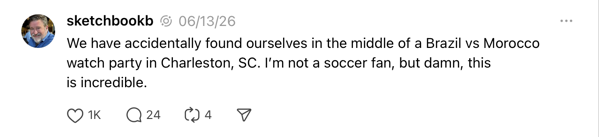
Post #1: World Cup Watch Party
The first was a post about accidentally landing in the middle of a Brazil-Morocco World Cup watch party.
On Micro.Blog, I got no comments.
On Bluesky, I got one like from a person I did not follow at the time.
On Threads, I got 1,074 likes and 24 comments on 13,051 views. Here’s the interesting part… only 83 of those views were from my followers.
Post #2: Slate’s Final Price
The second was a comment on the Slate truck…
On Micro.Blog, it sparked a conversation and at least one other post.
On Bluesky, I got one like from someone that doesn’t follow me.
On Threads, I got a like and a reply on 31 views, only 6 views from followers.
Clearly, if you want people to engage with your posts, the Threads algorithm can provide an audience. Bluesky didn’t generate much activity on either post, but I assume more than one person saw them. For the Slate post, Micro.Blog actually generated a conversation, and another blog post from one of the participants. I decided to follow up with a longer post as well.
These three timelines are different. I use them for different purposes. Is the Micro.Blog timeline quiet? Sure, but it’s full of unique and distinct voices including many I follow from Mastodon. I use Threads to follow pop culture, F1, WNBA, local news, and more. Bluesky has a bunch of academic and political experts that I enjoy following. Each timeline has a purpose. And the character of each is derived from the design of each service.
If I wanted to go all in on metrics, I’d be posting regularly to Facebook (823 friends), Instagram (707 followers), or LinkedIn (750 connections). I wouldn’t have deleted my Twitter account with over 1000 followers. But that’s not why I post on my blog.
I don’t think we’ll ever have a single dominant social media platform. The reality is that I’ve always had two or three different social media channels at a time. In the early days, I used Facebook, Instagram and Twitter. I still use three — Micro.Blog, Threads and Bluesky — but my current setup works better for me because everything is hosted on Micro.Blog and crossposted to other services. I value having all of my content on a single site.
We all use social media for different purposes. One great thing about today’s social media is that we have choices, but having more social media channels available means it’s harder to focus on a single outlet that meets all our needs. Each platform makes decisions that shape the experience, and that’s especially true in the case of Micro.Blog. In fact, I almost wrote a paper for a Ph.D.-level PR theory class a couple of years ago about how Micro.Blog’s structure aligns with Kent & Taylor’s framework for creating dialogic social media. Maybe someday, I’ll get around to writing it.
Bob Wertz is a type designer, Ph.D. student and researcher living in Columbia, South Carolina. He’s been blogging since 2008.
Honestly, four. I still share to Mastodon, but I don’t have any followers over there and don’t expect any engagement. ↩︎
I’m increasing intrigued by what’s happening with the AT Protocol and Bluesky. I’m finding myself on Bluesky more often as the user base grows. I like the basic concept of storing your data on a personal data server (PDS), with social apps filtering relevant data from a “firehose.” I’m fascinated by the idea of using the AT Protocol as a foundation of open science and academic publishing, even if I have lots of questions. I like where Standard.Site is going. Eurosky is doing interested things with some different AT Protocol apps.
I’m interested in Bluesky, but I don’t have the bandwidth right now to tinker with all of it. Micro.Blog creator Manton Reece has built a platform that interfaces with everything with an open API.1 Bluesky rolls out support for Standard.Site. Manton supports it. Bluesky starts to allow 12 pictures, Manton supports it. I’m not quite ready to spin up my own PDS, so hosting everything on Micro.Blog gives me the next best option.
The reality is that AT Protocol advocates see a world where everything is based on their vision of the open social web. I like their vision, but I’m not sure we’ll ever have one dominate protocol. (And as Dave Winer points out, Bluesky isn’t 100% billionaire-proof yet.) It’s best to cast a wide net and bet on interoperability. I host everything with Micro.Blog on bobwertz.com, but my content automatically crossposts to Bluesky (plus Threads and Mastodon).
And that’s why Micro.Blog is the perfect solution for people who want to experiment with different platforms, but maintain a centralized web presence. Manton’s built something amazing at Micro.Blog and I’m still surprised how few people know about it. Plans start at $5/month, but I pay $10/month for the premium plan, which includes multiple blogs, email newsletters, an alternative social media feed that allows me to follow people on Mastodon, bookmarking, an RSS reader, short video hosting an independent Goodreads alternative, and more. I can use it with desktop apps like MarsEdit and Ulysses. It’s phenomenal, and the best solution for me as we collectively figure out what’s next in social media.
Bob Wertz is a type designer, Ph.D. student and researcher living in Columbia, South Carolina. He’s been blogging since 2008.
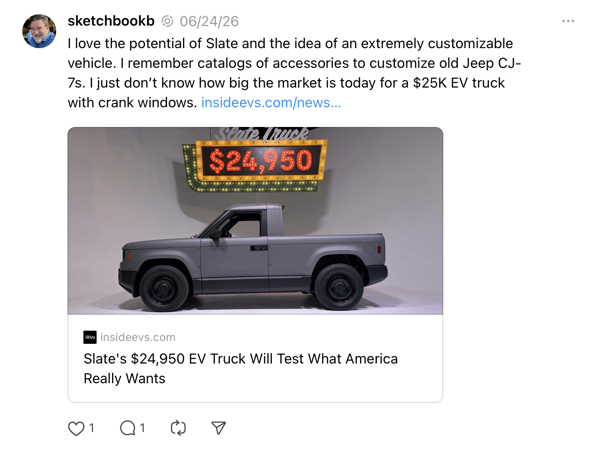
I don’t need a car right now, but in year or so, my daughter will need her car at college and I will need a car to take me back and forth to work. My wife won’t let me get a mini truck from local importer Japan Direct Motors, so maybe a Slate is the next best thing.
I’ve wanted an EV for a long while, but the timing just hasn’t been right. In a perfect world, I’d support Scout Motors which is building a factory outside of my hometown of Columbia, South Carolina. I love the way the Scouts look, but the starting price for a their very nice EV pickup is around $60,000. I’ve also eyeballed other cars like the Rivian R3, but who knows when that will finally hit the market. I like a small car, but many of the smallest EVs aren’t going to make it to the United States market.
And then there is the Slate. I’ve been interested in the bare bones basic truck since they announced it. I love the idea of an infinitely customizable vehicle that starts at a low price. Then add the features you want over time.
I think the price is right at $25,000. (Imagine if the $7,500 EV tax credit was still available!) They originally planned to offer two battery packs, but settled on a single option with a range of just over 200 miles. That will work for my daily commute with plenty of range anxiety cushion to spare.
I’d want to add some options of course… Probably a full body vinyl wrap, some speakers and maybe a center console. I also really like the look of the fastback, which adds $6,000 to the cost of the car. Browsing the Slate online configuration app, you can see how large the accessory ecosystem could become.
I still have questions. I want to see the crash test results and some more reviews. But after all of the announcements today, I’m absolutely still interested.
Bob Wertz is a type designer, Ph.D. student and researcher living in Columbia, South Carolina. He’s been blogging since 2008.
I don’t visit Facebook much, but I do occasionally check in. Late last night, after working on a typeface, I randomly decided to log into Facebook. I was startled to find out that a person I knew in college died unexpectedly. I was concerned about a friend and Lutheran pastor resigned from his call after 17 years. And I was happy to learn that a friend and her children saw my daughter at the camp she works at. And then, I was overwhelmed with ads and sponsored posts.
I haven’t had the Facebook app on my phone for six or seven years and I’ve maintained my Instagram pause since May. The side effect of focusing on more independent social media, though, is that I am detached from friends who are only on mainstream platforms. While I love Micro.Blog and Bluesky,1 most of the people I know in real life just aren’t active there. The reality is that I can’t completely leave Facebook and Instagram without losing connections to my friends and family.
Bob Wertz is a type designer, Ph.D. student and researcher living in Columbia, South Carolina. He’s been blogging since 2008.
I use Threads regularly, but I don’t love Threads. ↩︎
As part of my quest to get comfortable in Canva Affinity, I’ve been experimenting with some on-demand embroidery designs on Cotton Bureau. For embroidery, you are limited to a palette of 15 specific thread colors. When you create the product, Cotton Bureau tries to match the colors in your design to the available thread colors… which provides some unexpected results. Thankfully, Canva provides hex codes to approximate the thread colors.
To speed up my production, I made an Affinity Color Palette and figured I’d share. If you want to import the current Cotton Bureau thread palette into Affinity, here it is: 2026 Cotton Bureau Thread Colors.clr (ZIP archive).
Hopefully, it will save you a couple of minutes.
I’ve got one simple embroidered beanie on Cotton Bureau right now, my Dum Spiro Spero design, but I’ve got more embroidery designs in the works.
Bob Wertz is the Director of Research Training at the University of South Carolina, a Ph.D. student and typeface designer living in Columbia, South Carolina. He’s been blogging since 2008.
Rabbit Hole released a delightful video detailing the history of Lorem Ipsum, the meaningless faux Latin placeholder text derived from Cicero and used throughout graphic design. Definitely worth a watch.1
This video reminded me of my own funny little Lorem Ipsum story…
A long time ago, I worked at a large corporation as an in house design manager. One of our internal subsidiaries was struggling with profitability and brought a very senior, respected executive out of retirement to get the company back on track.
This executive asked that we meet with him to go over the direct mail marketing materials that our team had developed. The mailers were in the early stages, and the body copy was all placeholder copy — Lorem Ipsum. Our account manager and I walked through the current status and explained the design system. After we were done, the executive looked puzzled.
“We aren’t targeting hispanic markets. Why is this in Spanish?”
I paused, not wanting to embarrass him, but completely unsure how to respond. Our account manager took over with a simple “We’ll take care of it,” and the conversation moved on to next steps. I always appreciated her quick thinking.
Bob Wertz is the Director of Research Training at the University of South Carolina, a Ph.D. student and typeface designer living in Columbia, South Carolina. He’s been blogging since 2008.
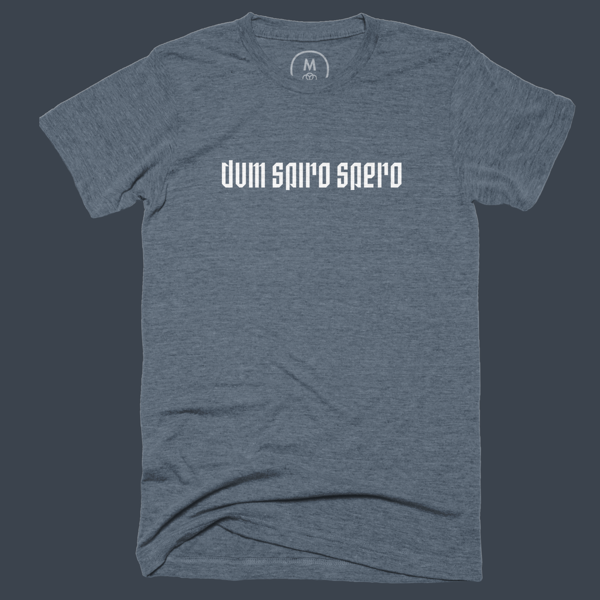
Dum Spiro Spero is the South Carolina state motto — “While I breathe, I hope.”1 It’s a beautiful statement of persistence and determination. Yes, the shirt is in Latin, and yes, that means you’ll have to explain it to people.2I recommend ordering a nice indigo blue.
If t-shirts aren’t your speed, there will also be an embroidered beanie soon, but the artwork isn’t ready quite yet.
Bob Wertz is a Ph.D. student, typeface designer, and native South Carolinian. He’s been blogging since 2008.
I’ve gone down a rabbit hole for the last few weeks. It started with a post about using Bluesky PDS servers to create a new method of scientific publishing.1
"The properties that make AT Protocol compelling for social networking are the same properties the research community has been asking for"
As someone who has embraced the ActivityPub and ATProto ecosystems, I wondered about what that process could look like, but kept getting stuck on how the peer review process would have to evolve to accommodate an open publishing environment.
Building an alternative academic publishing ecosystem isn’t only a technical issue. It’s an enormous cultural issue. How do you get academia to accept that anything other than double blind peer review as an acceptable form of quality control?
But with the new flood of AI articles and a lack of willing reviewers, at some point, academia will need to accept some alternatives to double blind peer review. It’s just not sustainable.
In my reading, I latched on to a specific issue that I think can be straightforwardly addressed. Once you’ve settled on an alternate method, how do you document an alternative review process in a manuscript that is self published in this hypothetical Bluesky-PDS-powered social environment?2
Step 1: Declare the alternative peer review process in your methods section.
When a journal publishes something, you know that it lives up to their editorial standards, but when you use an alternative peer review process, transparency is critical. Within the methods, you’d need to clearly state that this paper was subject to an alternative peer review. Here, I’m calling this hypothetical Bluesky review an “open social peer review”:
Prior to publication, this study was subject to an open social review process. Full details of the review are included in Appendix A.
I don’t think you need to include more than a few details here – basically just note the process used.
Step 2: Include the review process as a limitation.
At the end of your paper, it’s appropriate to note the review process as a limitation.
Because this study was not published in a traditional journal, peer review was handled through an open social review process. Every effort was made to ensure that thoughtful feedback was sought and incorporated into this paper. A full detail of the review process is included in Appendix A.
Include the review process as a limitation of the study, just like you might note any other sample or method limitation. No need to go into details, because that should all be in the appendix…
Step 3: Detail the process in an appendix.
In the appendix, start by describing the process in detail. For my hypothetical open social review, I’d included the timeframe of the review period, and explain how you found reviewers. Then provide a summary of the number of actionable comments and the number of qualified reviewers. An actionable comment is specific and can be addressed by the author. “I love this!” or “I hate this!” are not actionable comments. A qualified reviewer is simply someone who has deep interest in your project, likely with a terminal degree, who can provide valuable feedback about your background, methods or analysis. Finally summarize the themes of the comments and how you addressed them in the current draft. Here’s an fictional example from my hypothetical open social peer review process:
Appendix A: Open Social Review Summary
This study was shared on Bluesky PDS for open social review from March 22, 2026 to May 22, 2006. During this two-month period, 64 actionable comments were provided by 7 qualified reviewers. Reviewers were solicited through a series of requests on Bluesky during the review period. Each comment was reviewed and considered. Below is a summary of changes made to the manuscript based on the actionable comments.
Reviewers recommended that the article undergo a thorough proofread. Numerous edits were made to correct spelling and grammar.
Reviewers felt the study simply used “peer review” when it specifically was referring to “double blind peer review.” I have added a paragraph to clarify the definition and usage throughout the paper.
Reviewers recommended several citations that would be appropriate for inclusion. All noted literature was reviewed, and relevant summaries were added and cited.
This paper was published on May 30, 2026 based on the feedback listed above and is considered the final draft. While the original draft and all comments remain accessible on Bluesky, any feedback offered after May 22, 2026 was not included in the final paper.
This appendix section is similar to a letter that you would send to an editor after receiving a revise and resubmit detailing how you’ve addressed reviewers’ concerns. Seeing the comments and responses will allow readers to judge how rigorous and critical the review was.
Include any detail that you think might be necessary. For example, one note that would be important for my hypothetical Bluesky scenario is the end date of the review process. It’s possible that people might continue to comment and critique for years after an author has completed a draft. Clearly stating an end date for comments in the paper would be important since any Bluesky interactions will continue to be public.
Another round?
So if you’ve ever gone through the academic publishing process, you’ve likely gone through multiple rounds of reviews. What if you want to send your paper through another round of reviews? Again, I think you just note it in your paper and detail it in your appendix:
Prior to publication, this study was subject to a two-month long open social review process. Based on those comments, significant revisions were made and the paper was shared with a peer researcher to confirm that the changes were adequately addressed. Full details of the review are included in Appendix A.
If you are going to go through multiple rounds of reviews, why not change up the type of alternative review. The whole point is to transparently communicate your review process for the readers. Let them decide if the level of review was sufficient enough.
Straightforward documentation
Building an alternative peer review system is challenging, but I think the documentation approach for alternative review is comparatively simple. By placing a pair of notes in the narrative, you disclose your choice to use an alternative review process. Full documentation in the appendix — including both positive and negative feedback — will help you win the trust of the reader.
How practical is it to self publish research?
When Amazon popularized the eBook with the Kindle and .mobi format, they created an ecosystem perfect for self-publishing. Today, self-published ebooks are commonly sold and marketed on Amazon’s marketplace. It’s notable that the introduction of the ebook didn’t supplant traditional book publishing. They complemented them.3
Could a Bluesky PDS solution provide a workflow for self-published research? I’m not sure, but given the right tools, I think a self-published paper using some type of social-driven alternative peer review could become an intermediate step between a draft paper on a preprint server and a completed published paper. Google Scholar and other databases could easily provide discoverability for this new class of document. Similar to the rise of the ebook, this method of publishing won’t replace traditional academic publishing, but could instead complement it.
The reality is that alternative approaches might be appropriate for some types of science, but completely inappropriate for other disciplines. Can academic culture shift enough to allow a self-published manuscript to be something you could include on a CV without ridicule?
What do you think? Comment below using Bluesky, Mastodon, or Micro.blog.
Bob Wertz is the Director of Research Training at the University of South Carolina, a Ph.D. student and typeface designer living in Columbia, South Carolina. He’s been blogging since 2008.
I should disclose somewhere that this blog post was “peer-reviewed” by my amazing wife, a kindergarten teacher and education Ph.D. student who was justifiably concerned by my casual tone and use of dramatic sentence fragments. ↩︎
I found 11 images on Flickr that pre-date my use of Instagram and any of my blogs.1 I downloaded them and moved them to this site, preserving the original captions. My favorite from this bunch was actually the oldest… a shot from 2008 of a neon sign in a rain storm taken with my original iPhone from my car. I’m pretty sure I’ve reached the beginning of my public online presence with the addition of these images. I’m guessing that before these pictures, I used Apple .Mac galleries to share family pictures online — and those galleries are long gone.2 I did have a couple of portfolio sites — including one built in Flash — that are also not accessible, thankfully.
So why is it important to me to bring these all in one timeline? Because when I look at the complete picture — the blog, the early iPhone images, my tweets — I can get real snapshot of how I felt about things in that moment. This consolidation process is all about my desire to have a complete record of my online digital life, in one place. It’s a lot of work, but it makes me happy to have everything brought together. It feels like the digital equivalent of my Mom’s photo albums.
I still need to move a bunch of posts over from Sketchbook B. I’m wondering if I can automate some of the more time consuming parts of the process. We’ll see.
Bob Wertz is a type designer, Ph.D. student and researcher living in Columbia, South Carolina. He’s been blogging since 2008.
After these handful of images, it looks like I used Flickr as a backup for Instagram, and then I abandoned it altogether. ↩︎
Although the pictures and albums are safely stored in my Photos library… ↩︎
Older operating systems would just save files on a spinning hard drive any where there was space. Sometimes, large files would be split up and the segments scattered all over the drive. If this file fragmentation became bad enough, then it could hurt your system’s performance. If that happened, you’d run a utility to defragment your hard drive and reassemble those scattered files.
Well, I’m in the process of defragmenting my digital life. Since 2022, pretty much everything I’ve written or shared is here on bobwertz.com. But before 2022, my posts and images are scattered across the web on different sites and services. I want to have them in one place. Thanks to Micro.Blog’s import features, I already have a full archive of my Twitter posts and have moved more than 1,400 images over to this site from Instagram. I’ve been working on manually migrating my Sketchbook B blog posts to this site as well. I still need to figure out how to import Facebook posts, but I already have the assets downloaded.
So many people view online posting as ephemeral, but I’ve always viewed my online posts as permanent. Each is something that I intentionally wanted to share and remember. Once I finish the process of gathering everything, I’ll have a single, reasonably complete collection of my online life since December 2007 when I joined Twitter. I don’t really expect others to join me on this defragmentation journey. It’s a time consuming process. However, if you care about the stuff you’ve posted over the last few decades, you might want to start thinking about how to archive and preserve what you’ve shared.
Bob Wertz is a type designer, Ph.D. student and researcher living in Columbia, South Carolina. He’s been blogging since 2008.
How do I prepare to move away from Facebook, Instagram and Threads?
In 2016, I wrote a post about the things I would miss if Twitter went out of business. I identified potential pain points, and identified what steps to take just in case. After Twitter was acquired, I was able to easily leave my account.
Now, I’m thinking about what it would take to leave Meta’s products. I don’t think they are going to go out of business. They are the social media equivalent of “too big to fail.” I’ve long believed that Meta is an unethical company that builds addictive products. They’ve been awful for a long time, though, so why have I just made the decision to plan my exit? I used to enjoy Instagram, but lately, not so much. I’m posting less, and at the same time, seeing less content from people I know. I think it’s time to start the process.
When we talk about Meta, I’m talking about three products that I currently use: Facebook, Instagram and Threads. I started using Facebook in 2008 and have used Instagram and Threads since they were released.1 I now rarely log into Facebook, but I use Instagram and Threads regularly. I don’t use What’s App or Messenger, so those aren’t an issue for me.
I will note that some of the systems I adopted to leave Twitter help me with this new attempt to leave Meta. Since 2022, I’ve essentially run a P.O.S.S.E.2 set up (Publish Own Site, Syndicate Elsewhere) where most of my posts start on bobwertz.com via Micro.Blog and are then shared to Bluesky, Mastodon and Threads. Threads is the only Meta app that allows for this type of API access so it tends to be a little more integrated into my daily routine.
Looking at the Meta apps individually, here’s what I need to do to move away from Meta:
Facebook. I’ve mostly already left Facebook. On my About Bob page, it’s listed under “Not Updated Social.” The only thing left there are my old posts. And some of those old post contain awesome stories from when my kids were little. I downloaded a file with all the content, but I’d really like an online archive. Manton with Micro.Blog has said before that building a Facebook importer should be relatively easy. If he builds an importer like he did for Twitter, I can probably go ahead and close my Facebook page.
Instagram. Over the last few years, I’ve slowed my posting to Instagram. These days, I mostly use Instagram to view content. Increasingly, the content is ads, TikTok influencers, and AI slop. I was never a TikTok user, but I now understand why people love (and are addicted to) the short video format. Once you get sucked in, it’s easy to just sit there scrolling and scrolling. That said, I have lots of content I want to see and I think I’d rather spend my time watching one of the dozens of TV shows on my list, reading through my RSS feed, or even watching long form YouTube videos.
I do have over 15 years of images on Instagram, and while they all likely exist in my photo library, I still want to keep a record of them. Thankfully, Micro.Blog does have a way to import Instagram posts. I’ll need to do some manual clean up, since some of my Micro.Blog images are duplicated on Instagram. I’ve already downloaded my images and run a couple of test imports. It’s going to take a little while, but it’s worth it.
While I may not immediately delete the account, I do feel like I’m already at a point where I can step away. Sometime soon, I’ll probably drop a note in the bio that my Instagram feed is no longer updated, and then delete the app from my phone. I actually just flipped my account to private. I’ve always had a public account, but recently, it just seems that every new follower is a spam bot that I have to block.
Threads. Weirdly, even though it’s the social media network I’ve been on for the shortest period of time, Threads might be the hardest to replace for me right now. It’s connected to Micro.Blog, so crossposting is easy. It’s is a great source for niche news that I care about, for example: women’s college basketball and F1. While I feel like I could easily leave Instagram, I believe that Threads still adds some value for me.
But more importantly, Threads is also the place where I get the most engagement on what I share through Micro.Blog crossposting. Part of this is the Threads algorithm, but I also do know a bunch of people on Threads who respond to my posts… which leads to the biggest problem of all…
Meta’s apps are where people I actually know share updates.
The real problem with leaving Meta is that my family, friends and acquaintances are there. Facebook and Instagram especially. If I leave Meta’s ecosystem completely, how will I communicate with friends and family? How will I know what’s going on in the communities around me? Sadly, I guess the simple answer is that I won’t. No other ecosystem has the extensive network that exists on Meta’s platforms and with today’s fragmented social media infrastructure, no singular alternative is going to form to rival the number of users that Facebook and Instagram have. A very small number of my friends are on Mastodon or Bluesky.3 A choice to leave Meta products entirely is a choice to cut off connections. And I’m not 100% ready to completely sever those ties.
Which means I can’t quite get rid of Meta yet. But I’m actually closer than I thought I was. My plan is to look again at ways to preserve my Facebook and Instagram posts. I want an archive of everything. I’ll then completely pause activity on those platforms for the foreseeable future. I’ve long since deleted the Facebook app from my phone. Instagram will be next. I won’t delete those accounts yet. I’ll continue crossposting to Threads4 for the time being, but start to look for ways to get the same content on other channels. I wrote a total of six Twitterless posts, so I’ll likely follow up on this one eventually. Check back in on non-Meta social media for updates. Or just follow my RSS feed.
Bob Wertz is a type designer, Ph.D. student and researcher living in Columbia, South Carolina. He’s been blogging since 2008.
I joined Instagram the month it was released in October 2010. I joined Threads minutes after it was open to the public in 2023 and is user #210,850. ↩︎
For one year, I wrote a blog post about a random topic and designed a shirt inspired by the blog post.1 Lately, I’m giving myself some projects so I can learn to be more proficient in Canva Affinity and decided to design a t-shirt about my favorite Star Wars spaceship.
I was the perfect age when Return of the Jedi came out. And while I know that the Empire Strikes Back is the better movie, I have fond memories of seeing Return of the Jedi in theaters. And that’s probably why the B-Wing fighter is my favorite Star Wars ship.
If you haven’t seen a B-Wing, it’s a strange vehicle. It has a pilot capsule, and then the rest of the ship consists of one long wing, with a cross-shaped pair of wings that fold out. The whole ship spins around the pilot capsule like a gyroscope. When it lands, the wings fold up and it lays on its side. The B-Wing looked completely different than the other fighters… the X-Wing, the Y-Wing and the A-Wing. Plus it looked nothing like the letter B.
The B-Wing gets very little screen time in Return of the Jedi. Apparently, the wings of the ship were too thin with the special effects of the early 1980s and they would just disappear against the blue screen. But the B-Wing toy was amazing and I’ve long held a place in my heart for this odd little ship.
Since the original series, the B-Wing shows up in a few places. Star Wars Rebels gives the B-Wing an origin story in S2 E7 Wings of the Master. Designed in secret by a Mon Calamari ship designer, Quarrie, Hera convinces him to let the Rebel Alliance develop his “Blade Wing” fighter. The Alphabet Squadron book series includes a B-Wing. The B-Wing shows up a little in the Rise of Skywalker, but every ship shows up in the Rise of Skywalker.
At the end of Skeleton Crew, a couple of B-Wings show up in the final battle over At Attin and deliver the final blow to destroy the pirate mothership. Notably, this was the first time a B-Wing has been shown firing its main weapon in live action.
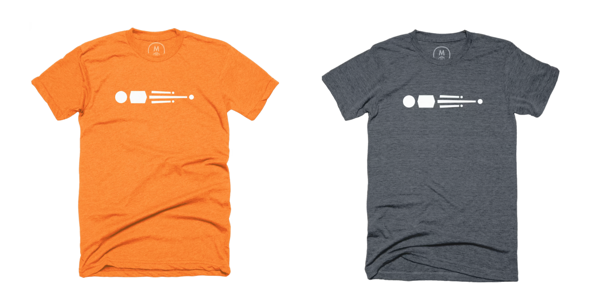
I decided that I needed some B-Wing merch so I created a new shirt on Cotton Bureau — Blade Wing. It features an abstract illustration of the B-wing in its landed configuration. You can get it in a couple of different colors. If you are also a fan of the most distinct fighter in the Star Wars universe, head on over to Cotton Bureau and grab a shirt.
Bob Wertz is a type designer, Ph.D. student and researcher living in Columbia, South Carolina. He’s been blogging since 2008.
My 52 Shirts project is over at Sketchbook B. I haven’t had a chance to move them all here yet. ↩︎
Being a type designer can be weird. You create your design. Share it with the world. And then someday, unexpectedly, it shows up again.
I designed SbB Powertrain over a decade ago and I was very surprised to see it pop up in a clip of Gamecock Women’s Basketball player Ali Tournebize dunking in the 2024 Eurobasket U18 bronze medal game. Turns out that FIBA uses Powertrain as part of the identity for their Eurobasket tournament. It was used heavily for the 2024 and it looks like they are still using it in some places. Here are a couple of examples that I stumbled across.
If you look closely to the videos, Powertrain is used for the 2024 at center court and on some of the courtside screens. So much fun to see my type design in use, especially in a global context. Learn more about SbB Powertrain and my other fonts at sbbfonts.com.
Bob Wertz is a type designer, Ph.D. student and researcher living in Columbia, South Carolina. He’s been blogging since 2008.
Apple seems to be one of the most tightly managed brands in the world, but they actually use their logo much more whimsically than any other big brands. I’ve written in the past about logo usagethat runs against typical brand management best practices. On the eve of their 50th anniversary, I’ve come across two more examples. I wanted to share them as a way to continue to document Apple’s approach to visual identity:
The 50th Anniversary “Logo”
Apple has artwork that essentially serves as an alternate logo for their anniversary. It’s a stylized treatment of their logo (below), which includes a rainbow of colors that harkens back to their old six color rainbow logo.
Both examples take the Apple logo shape and use it as a structure for artwork. You typically don’t see large companies allowing or promoting this kind of variability with their logo. And you rarely see an old logo pop up, even during an anniversary. The artwork feels true to the Apple brand, but runs counter to what other brands do. In brand management, rigid consistency is king. As designers, it’s worth noting that Apple of all companies allows such flexibility within their visual identity guidelines, and maybe we can learn something from how they use their logo and brand creatively.
Bob Wertz is a type designer, Ph.D. student and researcher living in Columbia, South Carolina. He’s been blogging since 2008.
I have three kids — one in college, a senior in high school and a middle schooler. They’ve grown up in a school district where they’ve had their own Chromebooks for the majority of their education. They use Google Docs and Slides, plus a host of online tools like Canva. Chromebooks dominate the K-12 education market, but once they graduate, what do they use?
When my oldest went off to college, we purchased an M2 MacBook Air and that’s been the computer that she’s used for the last three years. It’s a great computer, but honestly, it was far more powerful than she needed.
When my senior in high school heads to college in the fall, she’ll be taking a MacBook Neo1. It’s the perfect computer for what she needs, and a massive step up from the crappy Chromebooks that she’s used for the last decade.
Kids raised with Chromebooks are comfortable with the laptop form factor, and the MacBook Neo is a nice step up for kids heading to college. Affordable, and as a bonus, it works well with the iPhone they likely already have. I expect that next year across campus, most of the computers I’m going to see will be MacBook Neos. It’s a computer made for college campuses.
Bob Wertz is a type designer, Ph.D. student and researcher living in Columbia, South Carolina. He’s been blogging since 2008.
I plan on blogging about my dissertation process, and I figured I’d start with something basic — my choice of writing tools. I wanted to use some less traditional tools when writing my dissertation. When I’m writing for myself, I write in Markdown, usually in an app like Ulysses. I considered something more robust like Scrivener. But neither Ulysses nor Scrivener works easily with Zotero, my chosen citation management program which already contains years of sources and notes on my topic. I was intrigued by Essayist, a new academic writing tool for Mac, iPad and iPhone. It looks well-designed, but has its own built in citation manager. Theoretically, I could export my Zotero Library in a BibTeX format and import the entries into Essayist, but I’m just not confident it will work.
That leaves me with two options: Microsoft Word or Google Docs.
I want to be able to write on my Mac or iPad so honestly, Microsoft Word is the better option for me. Google Docs is frustrating to use outside of a desktop browser. Subscription cost isn’t an issue since the University of South Carolina is a Microsoft school and we’ve already got an Office 365 subscription. It’s a boring choice, but given my requirements, it’s the right choice.
Bob Wertz is a type designer, Ph.D. student and researcher living in Columbia, South Carolina. He’s been blogging since 2008.
For 13 years, I managed the visual brand of the University of South Carolina. I led creative teams and worked with vendors and agencies. I produced banners, designed signage, wrapped buses, worked on TV commercials, and installed 6-foot high USC letters. And while I loved my time as the “Guardian of the USC Brand,”1 this summer, I started to think about making a career change. I’m getting close to finishing my Ph.D. The design industry has changed in countless ways since I started my career almost 30 years ago, and while some of it is great, there are other parts that I don’t love as much. I wanted to stay at USC, so I started looking for other jobs on campus that I felt like would be a good next step for me.
I assumed that role would be a communications job in a different unit on campus. Or maybe a teaching position. I couldn’t wrap my head around what a new career could look like. Making a career change is hard, especially when you are moving from a job that is perceived as more of a “calling.” Design was more than just my chosen profession… it was my identity. I added USC’s jobs listing to my RSS feed and checked every day to see what new opportunities were posted.
One day in early September, I saw a posting for a Director of Research Training position. I read through the post and instantly thought that this was a job I’d enjoy. And then, I started second guessing myself. Was I really qualified for the job? Would I even be happy in a non-design job? I bookmarked the job, but moved on to look at other options.
A couple of days later, I randomly came upon a link to a YouTube short from a podcast with Simon Sinek2 interviewing Arthur Brooks from Harvard Business School about career changes.3
The basic gist of the clip was that most people limit a career change search to something close to what they already do. Instead, Brooks and Sinek suggested that you should look at how your skills, abilities and interests could be leveraged in other careers. Ask yourself “What is my greatest area of interest?" Your instincts should guide you in these decisions. Ideally, Brooks noted, you want to go into a career change with 80% excitement, 20% fear and 0% deadness.
I thought back to the research training position description and looked at it through this new lens. I was limiting myself to adjacent career fields — only considering typical communications or design jobs. Through my grad school experience, I learned that I really enjoy academic research. I loved working with the campus community. Was there a little fear leaving the design world? Absolutely. But that fear was overwhelmed by the excitement of something new. I took a chance, decided to apply and figured I’d see what happened.
The interview process went incredibly well, and right before Christmas, I started my new job: Director of Research Training in the Carolina Grants and Innovation Hub at the University of South Carolina. It’s part of the Office of the Vice President of Research and is focused on helping faculty and staff maximize grant opportunities. It’s very different than what I’ve done for the last few decades, but it’s very much aligned with where I want to go with my career. I’ve only been in the office for a about a month, but so far, I couldn’t be happier with my choice. I feel better than I have in a long time.
Bob Wertz is a type designer, Ph.D. student and researcher living in Columbia, South Carolina. He’s been blogging since 2008.
That phrase was literally in my job description. ↩︎
Humorously, my former boss was a huge Simon Sinek fan. He left after an absurdly short stay at USC, but the only reason I noted the video was Simon’s involvement. So I guess I have him to thank… ↩︎