W

W
Beer.

This post was originally posted on March 18, 2018 on Sketchbook B. It’s reposted here as part of a project to move some of my favorite writing to my new site.

Each week for a year, I’m designing a shirt and releasing it on my Threadless store. This is the design for week 39.
I recently read an article by Don Lincoln, a physicist at Fermilab* describing a potential new discovery that sheds light — pun intended — on the formation of the universe. But what struck me about the article is his discussion of what happened after the Big Bang, how the universe expanded and formed planets and stars.
For some reason, science advocates and religious advocates are diametrically opposed these days. If you believe in basic scientific principles, some people assume that you don’t believe in God. And if you are Christian, some people assume that you believe that science is a hoax and the earth is only 6,000 years old.
But I’ve never felt my faith in God and my belief in science have been at odds with one another. I believe in evolution, climate change and vaccination. I also believe in the Father, Son and the Holy Spirit. I feel that modern science is just one of the tools that God has given us to experience and understand his creation. I can believe in God while accepting that the Earth formed in more than 6 days.
In short, I believe in both God and science. And this week’s shirt is a rather direct statement of that belief. Of course, the shirt is only available in shades of gray…
You can buy “God and Science” on my Threadless store.
* I grew up in Batavia, Illinois, a suburb of Chicago and the location of Fermilab. I took many a field trip to the particle accelerator in our neighborhood.
Bob Wertz writes about design, technology and pop culture at Sketchbook B. Bob is a Columbia, South Carolina-based designer, creative director, college instructor, husband and dad. He’s particularly obsessed with typography, the creative process and the tools we use to create. He’s currently in the middle of a project to design a new shirt a week for an entire year.
Fun watching these two play. Daycare buddies on opposing teams tonight.

This post was originally posted on March 11, 2018 on Sketchbook B. It’s reposted here as part of a project to move some of my favorite writing to my new site.

Each week for a year, I’m designing a shirt and releasing it on my Threadless store. This is the design for week 38.
My first computer, a Commodore Vic 20, actually used cassette tapes for data storage. We upgraded to a Commodore 64 and it used a 5.25 inch floppy. So did the TRS-80 at school and the IBM PC at my dad’s office. When I got to high school, the 5.25 in drives gave way to 3.5 inch floppies. And while I was in college, the 3.5 inch floppy was replaced by a Iomega Zip drive that held an “amazing” 100 MB. Zip drives were popular until writeable CD-ROM drives became commonplace. Writeable DVDs seemed to be the natural next step, but USB thumb drives were cheaper and more convenient. Now, everything pretty much lives in the cloud.
There were — of course — storage devices that never caught on… I remember 44 MB and 88 MB SyQuest Drives. Iomega had a 1 GB Jaz Drive and introduced a 250 MB Zip drive to capitalize on the success on the 100 MB Zip Drive. Portable hard drives are still popular with people who need a lot of storage, but USB thumb drives are getting cheaper and increasing in capacity. Writable Blu-ray discs are expensive and take forever to burn.
I’ve watched computer storage evolve over the last 30+ years and now, we’ve reached a point where everything is in the cloud and there is very little reason to have physical media at all. There’s a part of me that misses carrying around all my files and projects and a collection of Zip disks, but I won’t miss the fear of losing a disk or having one fail catastrophically. Now, all my files are available to me on pretty much any device at pretty much any time.
This week’s shirt, “The Evolution of Storage” is a look back to the changes of how we store our important files and projects. Starting with 1.2 MB and spanning to the now seemingly infinite cloud.
You can purchase “The Evolution of Storage” on my Threadless store.

Bob Wertz writes about design, technology and pop culture at Sketchbook B. Bob is a Columbia, South Carolina-based designer, creative director, college instructor, husband and dad. He’s particularly obsessed with typography, the creative process and the tools we use to create. He’s currently in the middle of a project to design a new shirt a week for an entire year.
This post was originally posted on March 4, 2018 on Sketchbook B. It’s reposted here as part of a project to move some of my favorite writing to my new site.

Each week for a year, I’m designing a shirt and releasing it on my Threadless store. This is the design for week 37.
Several years ago, I was looking for new podcasts to listen to. I was regularly listening to Upgrade with Jason Snell and Myke Hurley and Myke mentioned that he had another podcast, The Pen Addict. An entire podcast on pens? I was curious and so I downloaded an episode to check it out. It didn’t take long before I had a collection of different writing utensils, inks, bags and sketchbooks.
I’ve mentioned before how uncomfortable I am with my handwriting and writing in general, but with better tools, writing was far more enjoyable. I really like writing with a fountain pen. Choosing the ink and the right nib style. Cleaning and taking care of them. I love the feel of drawing with a good mechanical pencil. I adore sharpening a wooden pencil and getting a perfect point.
Most people don’t think about what they write with. They use the pen in the office supply cabinet or whatever happens to be laying around the house. The last wooden pencil they used was a cheap #2 in elementary school. There is nothing wrong with that approach, but I believe the experience of writing changes when you use a good pen or pencil.
One of my earliest sketches for this shirt-a-week project was a short, fat pencil and I refined it into this shirt, Pens and Pencils. I’m going to the Atlanta Pen Show in April and figured I’d release the shirt now so I can order one and wear it to the show.
You can buy Pens and Pencils at my Threadless store.
Bob Wertz writes about design, technology and pop culture at Sketchbook B. Bob is a Columbia, South Carolina-based designer, creative director, college instructor, husband and dad. He’s particularly obsessed with typography, the creative process and the tools we use to create. He’s currently in the middle of a project to design a new shirt a week for an entire year.
My shirt-a-week project continues. I’ve posted 36 shirts… 16 to go. For more info, check out the link in bio.

This post was originally posted on February 25, 2018 on Sketchbook B. It’s reposted here as part of a project to move some of my favorite writing to my new site.

Each week for a year, I’m designing a shirt and releasing it on my Threadless store. This is the design for week 36.
I was in 6th grade and had saved my paper route money to buy “California Games” for my Commodore 64. I opened the box in the car on the drive home to look at the instructions and found a scratch off game card. Scratch off three circles and if they match, you win that prize. I scratched off three circles and they matched. I shouted in a mix of confusion and joy… “I won a jet ski! What’s a jet ski?” My mom didn’t believe me — and since she was driving, she got my older brother to take a look. He confirmed that I had, indeed, won a jet ski.
And that started one heck of a lucky streak. Over a couple of decades, I won a bunch of stuff… radio contests, door prize drawings, golf clubs, an iPod, season tickets for minor league hockey, software, a watch, a framed print and more. For a number of years, every time there was a door prize, I knew I was going to win it.* It was fun, although occasionally embarrassing. The streak seems to have ended a number of years ago, but I always wonder if the streak will ever kick back in.
In honor of St. Patrick’s Day and my own crazy luck, I wanted to create a “lucky” shirt. And since my beloved Commodore 64 had lovely eight bit graphics, I figured a pixelated pot of gold was the perfect tribute to my amazing lucky streak.
You can buy Lucky at my Threadless store.
*Everyone asks if I ever won the lottery. I have not. Some odds are too impossible.
Bob Wertz writes about design, technology and pop culture at Sketchbook B. Bob is a Columbia, South Carolina-based designer, creative director, college instructor, husband and dad. He’s particularly obsessed with typography, the creative process and the tools we use to create. He’s currently in the middle of a project to design a new shirt a week for an entire year.
Chapin JV Lacrosse pre game huddle at AC Flora. 11-2 win.

The lucky garnet jacket is still lucky.

This post was originally posted on February 18, 2018 on Sketchbook B. It’s reposted here as part of a project to move some of my favorite writing to my new site.
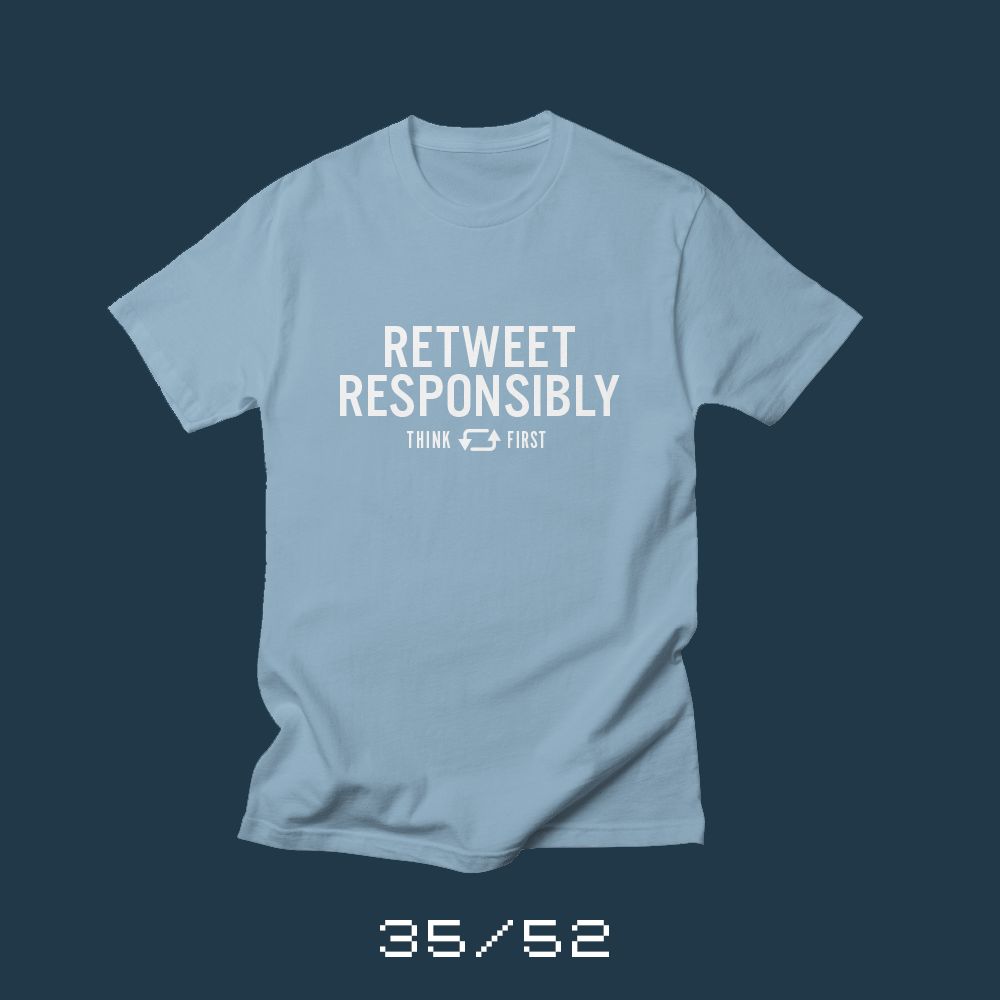
Each week for a year, I’m designing a shirt and releasing it on my Threadless store. This is the design for week 35.
The school shooting in Florida this week was heartbreaking. Heartbreaking because of the loss of life. Heartbreaking because this keeps happening and no one acts to try and prevent it from happening again. Heartbreaking because I send my wife — a teacher — and three kids to school every day and pray that they are never placed in harm’s way.*
In the aftermath of the shooting, social media was … chaos. I know that friends were hurting and angry like I was. They wanted to make a point that something has to change. I get it, and yet, many of them were retweeting things that were false or exaggerated. Bogus stats. Exaggerated claims. Speculation.
Gun advocates were rushing to similarly harshly drawn conclusions. Recommending “solutions” like arming teachers. Tweeting and retweeting false or inflammatory statements — anything they could do to shift the blame towards something other than the American gun culture.
And as if that wasn’t enough chaos, Russian bots jumped into the fray stirring up trouble in their own way.
Here’s the thing, though. When you push false or hastily checked information, your side in the debate suffers. Even if you are mostly right, the minute you stop offering facts and a path forward, you lose credibility.
Retweeting — or sharing on Facebook — information that you don’t know is true, but you want to be true… it does more harm than good. You are as responsible for the things you retweet as the posts your write yourself. When you share something, you personally endorse that you believe it. So spend a few minutes researching before you hit the retweet button.
Twitter and Facebook reward the quick retweet or share.** They are designed to allow you to react with minimal thought. Don’t fall for it. Don’t feed the outrage machine — there’s enough to genuinely be outraged by. Think and help advance the discussion, because something has to change and we have to get there together.
You will be able to buy Retweet Responsibility at Threadless.
* Heartbreaking because I know the feeling of fear that comes with a lockdown. I’ve been in a active shooter situation twice in the last five years. Once at the University of South Carolina because of a murder-suicide. And once with my entire family at a local mall when there was an apparent shooting.
** I’m beginning to appreciate Manton’s hesitation in introducing reposting to Micro.Blog.
Bob Wertz writes about design, technology and pop culture at Sketchbook B. Bob is a Columbia, South Carolina-based designer, creative director, college instructor, husband and dad. He’s particularly obsessed with typography, the creative process and the tools we use to create. He’s currently in the middle of a project to design a new shirt a week for an entire year.
This post was originally posted on February 11, 2018 on Sketchbook B. It’s reposted here as part of a project to move some of my favorite writing to my new site.

Each week for a year, I’m designing a shirt and releasing it on my Threadless store. This is the design for week 34.
I grew up fascinated with space. I had books on the space shuttle. I wanted to go to Space Camp.* I watched movies and documentaries about the Apollo program. I remember the loss of Challenger. And the loss of Columbia. As the shuttle program came to an end, I followed along with the International Space Station and all the probes and rovers that we’ve sent out to the solar system. I listen to a podcast about space regularly. But with our future of space exploration in doubt, I admit that my excitement has waned a bit over the years.
This week, Space X reignited that excitement.
Falcon Heavy — the largest rocket launched since the Saturn 5 took astronauts to the moon — completed a successful test launch.
The launch was spectacular, but for me the highlight was the landing of two boosters in unison. Online, I saw too many people focused on the Tesla Roadster now floating towards the Kiper belt, or the loss of the third booster. But the Falcon Heavy represents the next step to returning to the moon, and maybe someday heading to Mars. Falcon Heavy is a big deal, and the test was a massive success.
“The launch was spectacular, but for me the highlight was the landing of two boosters in unison.”
I started the day as the only one I knew excited about the launch. I gathered my coworkers around the screen as I watched the launch live — with commentary from Jason and Stephen from the Liftoff Podcast. Some of them weren’t sure what it was a big deal. Others had no idea there was a launch happening. But it was wonderful to share the experience with my friends.
Later, after dinner, I shared the video with my wife and kids when I got home and talked about the launch and space exploration in general. Space X and Falcon Heavy have given people a reason to be excited about space again. I hope they continue to push forward.
I wanted to celebrate this new excitement with this week’s shirt, Rocket. It’s a Falcon Heavy roaring out of the atmosphere. You can buy Rocket at my Threadless store.

Closeup.
* And yes, this probably had something to do with the movie, Space Camp.
Bob Wertz writes about design, technology and pop culture at Sketchbook B. Bob is a Columbia, South Carolina-based designer, creative director, college instructor, husband and dad. He’s particularly obsessed with typography, the creative process and the tools we use to create. He’s currently in the middle of a project to design a new shirt a week for an entire year.
Good catching coffee with this guy today.

This post was originally posted on February 5, 2018 on Sketchbook B. It’s reposted here as part of a project to move some of my favorite writing to my new site.

Ten years ago today, I launched this blog. My plan was to use Sketchbook B as a home for a bunch of side projects that were rattling around in my head. Typefaces and photography, mostly. I’d spent most of my career up to that point as an art director in the insurance industry and I needed a home for more creative endeavors — projects that would keep me energized when the day job was a little too straightforward.
Over the last decade, I’ve averaged about a post a week. Roughly 520 posts. And while I’ve posted about creative projects, I’ve also written about just about everything else you can imagine. I’ve written about my community. I’ve gone through phases where I was providing weekly InDesign tips. I split out an entire “off-topic” blog. And then I merged it back in with the main blog. I added Google ads. I took them out. I’ve written long posts and short posts. I’ve written about social media, pens, cars and popular culture. It’s been an ongoing experiment.
In 2016, I tried to get serious about Sketchbook B. And by serious, I mean that I tried to have a publishing schedule and build an audience. In the process, I stopped writing the things I wanted to write and started writing things I thought my “audience” would read. Two things happened… my traffic increased slightly and I no longer enjoyed writing posts.
As 2016 came to an end, I knew I needed to make a change and started to think back to why I started Sketchbook B. It was a creative outlet. It was my creative outlet. I needed to start writing for me and stop writing for statistics.
“I needed to start writing for me and stop writing for statistics.”
I spent a day at a coffee shop that December thinking and sketching. Planning. In January, I stumbled across the Micro.Blog kickstarter that made me think even more critically about my writing online. I read Stephen King’s “On Writing” which really challenged me to think about what I was writing — and more importantly — why I was writing.
That process led directly to the 52 Shirts project that I’m in the middle of. I love designing the shirts, but I also love writing the blog post that explains what I’ve created. I tell people all the time that the project isn’t just the shirt design, it’s the design and the explanation.
I’m writing about topics that interest me again. And two things have happened… my traffic has increased slightly and I love writing.
So here I am, ten years into this blog and I feel like I’ve finally found my voice. I’m excited to be writing regularly. I’m becoming a stronger writer and recognizing areas where I need to improve. I’m working hard to push outside my comfort zone.
I’ve got some plans for what I want to do over the next couple years with Sketchbook B. Plans can change, but I’m looking forward to what’s ahead.
And most importantly, I can honestly say that I’m more excited about Sketchbook B today than I was ten years ago when I launched it.
Bob Wertz writes about design, technology and pop culture at Sketchbook B. Bob is a Columbia, South Carolina-based designer, creative director, college instructor, husband and dad. He’s particularly obsessed with typography, the creative process and the tools we use to create. He’s currently in the middle of a project to design a new shirt a week for an entire year.
This post was originally posted on February 4, 2018 on Sketchbook B. It’s reposted here as part of a project to move some of my favorite writing to my new site.

Each week for a year, I’m designing a shirt and releasing it on my Threadless store. This is the design for week 33.
I’ve been writing here on Sketchbook B for ten years this week — about 520 posts. Basically averaging a post a week for ten years. Most blogs don’t make it ten posts, but I’ve kept this site going consistently for a full decade.
Recently I started to talk to friends who had blogs, and now don’t. And their reasons for abandoning their blogs were all pretty much the same… it didn’t feel like anyone was reading. No one cared. And so, they stopped writing.
Believe me, I understand that feeling. I’ll craft a blog post that I think is great, and ten people will read it. Being an obscure blogger can be discouraging.
Over the last year, I’ve recommitted to writing for myself and I’ve been happier with the posts I’m publishing. Every so often, I’ll look at my analytics and slip into the “no one cares about what I’m writing” trap, but for the most part, I don’t allow traffic — or more precisely, the lack of traffic — bother me. I write for me, and I hope people like it and go away inspired.
I wanted to design a shirt to commemorate not just the ten years of Sketchbook B, but also the struggle of the obscure blogger. The person who writes in relative anonymity, because they love writing.
This week’s shirt, Obscure Blogger, I wanted to use one of my typeface designs, so it features one of my Fontstruct designs — SbB Epyx — and the tagline “Entertaining and informing dozens since 2008.” 2008 was the year I started Sketchbook B, but I’m happy to make custom variants with different dates if you want them. Just reach out and let me know what year you started your obscure blog and I’ll add it to the Threadless store, too.
You can purchase Obscure Blogger at my Threadless store.

A closeup, since it’s a little hard to read on the mockup.
Bob Wertz writes about design, technology and pop culture at Sketchbook B. Bob is a Columbia, South Carolina-based designer, creative director, college instructor, husband and dad. He’s particularly obsessed with typography, the creative process and the tools we use to create. He’s currently in the middle of a project to design a new shirt a week for an entire year.
Norah’s first Chapin JV lacrosse game.

Writing at Indah Coffee this morning.

President Pastides talking to the media about the impact USC makes on South Carolina. #uofscimpact

Press conference kicking off @onecolumbia cultural planning process, Amplify Columbia.

Warning!
