When the internet was becoming popular, I remember being told that traditional media was just broadcasting. The internet promised more than just broadcasting, it offered “engagement.”
Don’t let people fool you. Engagement happened before the internet. People read the newspaper and talked about stories with their family and friends. They watched the evening news and discussed it at the water cooler at work the next day. They wrote letters to the editor to express their agreement or disapproval. They called radio shows to ask questions. They bought classified ads to share a job listing or sell a car. People engaged with media before the internet.
Instead, what the internet offered was an instant, two-way feedback loop between publisher and audience. Comments on blogs and news sites led the way. Then, social media provided the ultimate in real time engagement with metrics that let you track everything.
Instant response. Maximum engagement. Integrated with the content.
And how has that worked out? Thoughtful comments on blogs were quickly drowned out with spam. News sites were filled with reactionary opinions. Social media offered both reactionary opinions and spam and as a bonus channeled hate and harassment. Managing commentary takes as much staff and resources as creating the content, but people love providing their opinion and arguing their point of view, which drives traffic. And that traffic was the most important thing to the companies like Facebook and Twitter that sell the advertising that surrounds the hate.
As Twitter implodes and some people look for what’s next, I think we need to reexamine the relationship between publishing and engagement. Creation and commentary. True engagement is what follows when we create high-quality, beneficial content. We need to restore a focus on publishing the content, not just on the commentary. And our new technologies need to support that balance.
P.S. One of the things I like about Micro.Blog is the absence of metrics. No follower counts. No likes. No retweets. If you are used to obsessively checking how many likes your last post got, the absence of metrics takes a little getting used to, but it resets the balance between publishing and engagement.
P.S.S. It occurs to me that the most profitable company in the world, Apple, creates a lot of content without maintaining a traditional social media presence.
One thing that Twitter excels at — which will be difficult to replace — is commentary during live events. Last night, I was able to follow a range of commentary on several college football games and the World Series all from my Twitter feed.
It’s not just who I follow, it’s also the way the service is constructed. When following a bunch of live events, you need to use the non-algorithmic timeline. Twitter still, begrudgingly, allows for that. Facebook has many of the people I follow on Twitter, but the comments are jumbled, appearing whenever the algorithm decides, often incoherently out of order. And I can’t see following my South Carolina Gamecocks on another large service, like Linked In. 🤣
Perhaps the real question is if I need the stream of commentary at all? I get value out of live commentary from sports journalists and other fans. I feel like it ads to my enjoyment, but I enjoyed watching games before Twitter existed. Maybe live events is one of those areas where I need to reexamine my reliance on social media.
This post was originally posted on December 28, 2021 on Sketchbook B. It’s reposted here as part of a project to move some of my favorite writing to my new site.
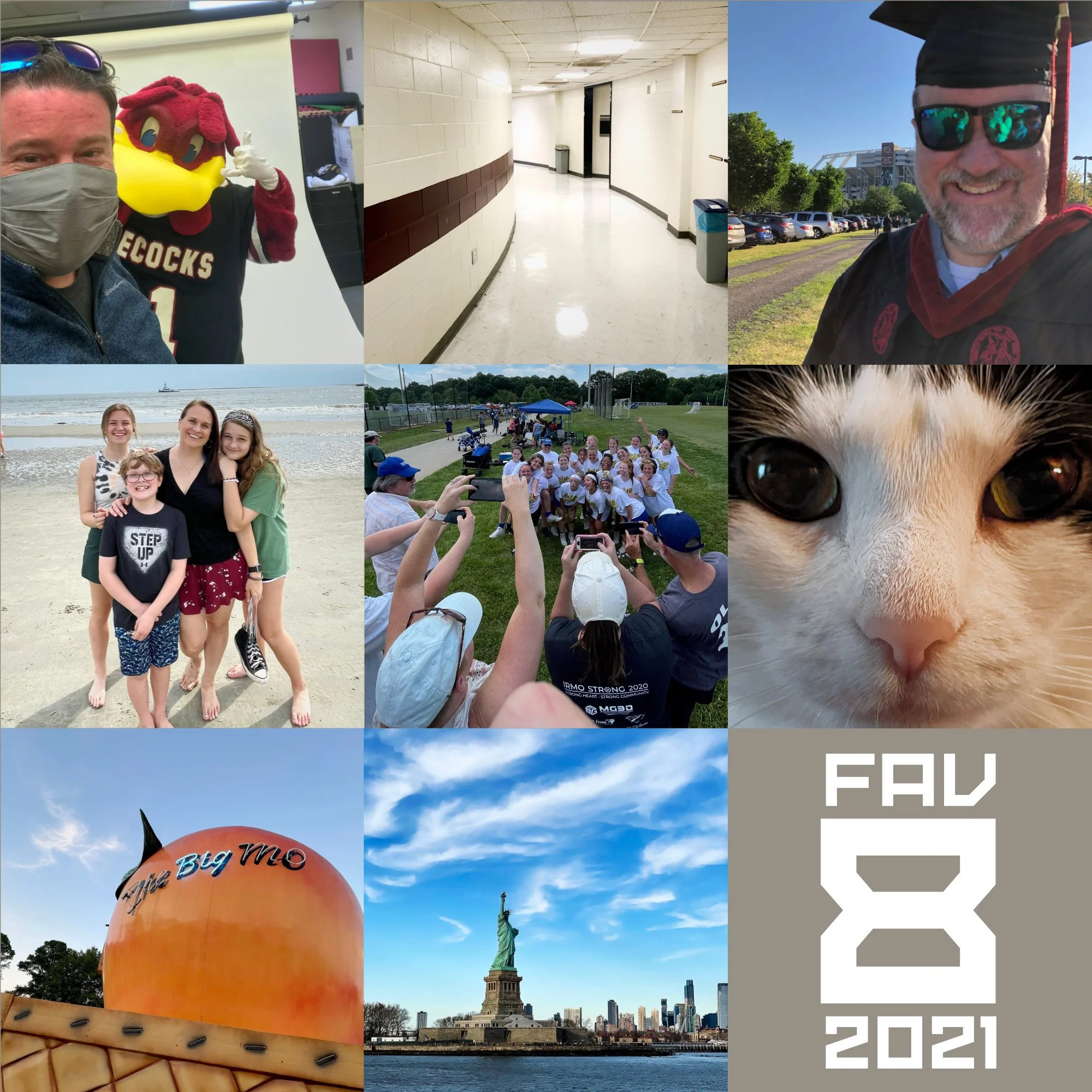
My favorite shots from the last year.
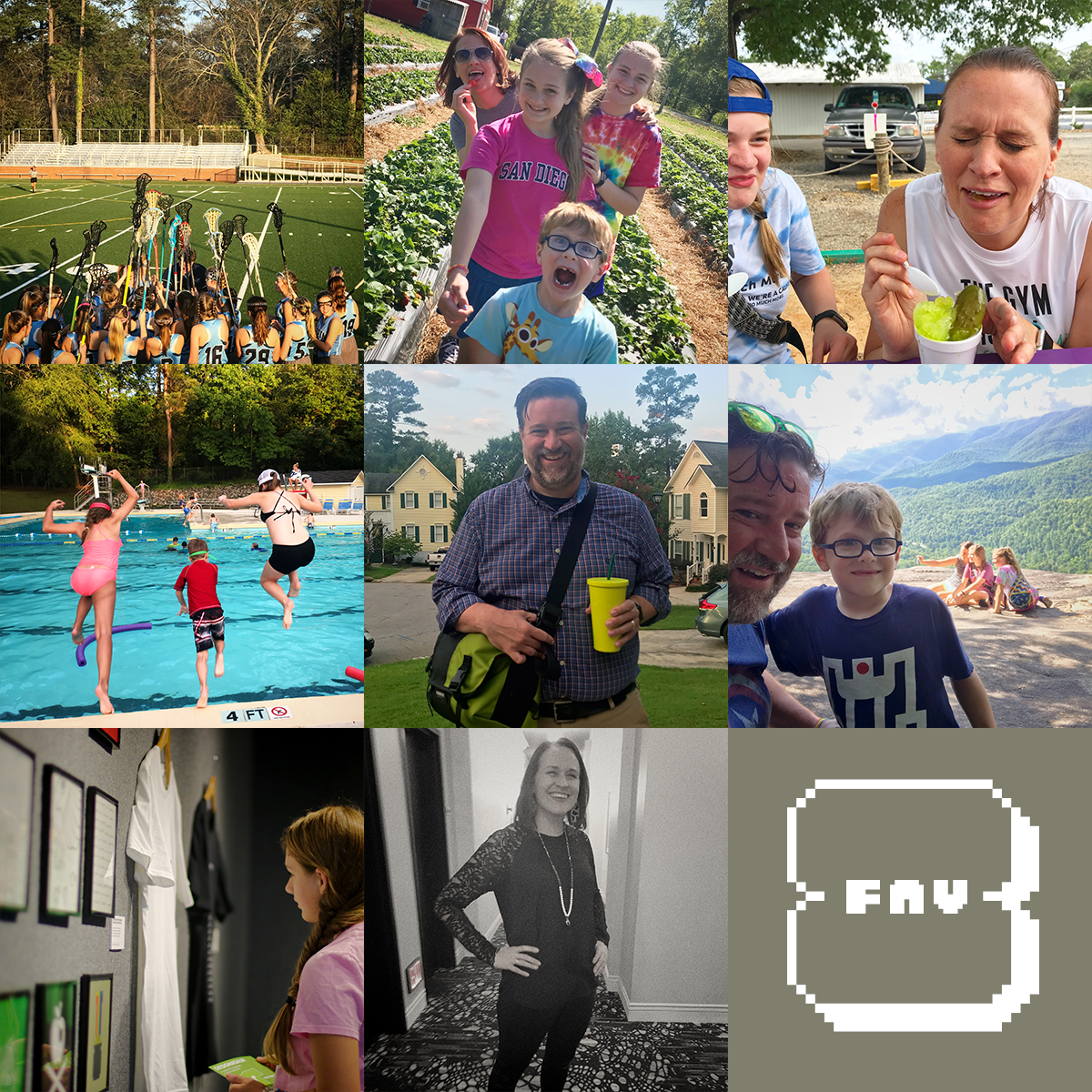
A few years ago, I started picking my eight favorite shots from the last year instead of the automated top 9 that had become popular on Instagram. I’ve written about the process* before so I’m not going to recount that here, but here are my favorite eight shots from the year. (I took lots of shots I liked this year and it was actually really tough to narrow it down to eight shots. I could have picked eight shots just from just our New York trip.)
Cocky. The year started with a photoshoot with Cocky and we used FaceTime to call my Cocky-obsessed niece.
Carolina Coliseum. On the same day as the photo shoot, I grabbed this shot of the empty hallways of the Carolina Coliseum. That’s where the journalism school was when I was an undergraduate student.
Masters. This spring, I graduated from my MA program. The commencement ceremony was held at Williams-Brice Stadium because of COVID.
Beach. The family at the beach in Charleston. Love this shot of everybody.
Lacrosse. Norah’s club team won their bracket at a tournament in Lake Norman, North Carolina. They rallied to win four straight and she played really well. The team posed with their championship shirts after the final.
Ruby. Our cat. Love the detail in this super close up shot.
The Big Mo. We weren’t ready to return to the theatre, but we wanted to see Shang Chi. So we headed to the Big Mo, a drive-in theatre in Monetta, South Carolina.
Lady Liberty. We made a trek to New York with the family right before Christmas and visited Liberty Island.
* One change from my previous process: I made this years collage in Affinity Photo instead of Photoshop.
Bob Wertz writes about design, technology and pop culture at Sketchbook B. Bob is a Columbia, South Carolina-based designer, University of South Carolina Ph.D. student, mass comm researcher, husband and dad. He’s particularly obsessed with typography, the creative process and the tools we use to create. He got vaccinated and boosted to protect his community. #TeamModerna
This post was originally posted on May 30, 2021 on Sketchbook B. It’s reposted here as part of a project to move some of my favorite writing to my new site.
Time to start using Micro.Blog more
Every so often, I realize that I’m not happy with my social media setup. I had been using Micro.Blog paired with Squarespace since the service launched and I was happy with how my regular blog could connect via RSS with my social media feeds. I’ve written about it in the past, but basically, with my original Squarespace/Micro.Blog setup:
I posted to my microblog here on Sketchbook B and it showed up on Micro.Blog and Twitter.
Any main blog post with the category “micro” posts to Micro.Blog and Twitter.
When I redesigned Sketchbook B, the new Squarespace template didn’t play well with my self-hosted micro blog set up. The template couldn’t figure out how to deal with titleless posts. I spent some time trying to figure out how to fix it, but after a while, decided that maybe it was best if I started using Micro.Blog for posting and hosting.
I never got around to really setting things up again. A pandemic. The election. Working from home. And I had a thesis to write. But now that I’m finished with my Master’s degree, I’ve got time to think through how I want this to work. (At least until August when I start working on my Ph.D.)
So here’s the new plan:
Short posts start on Micro.Blog using either the Micro.Blog app or my favorite writing app, Ulysses. They are then crossposted to Twitter.
Main blog posts — like this one — on Squarespace with the category set to “micro” will still show up on Micro.Blog and Twitter.
Limit my time and interactions on Twitter. Continue to avoid Facebook.
A couple of notes about the new setup:
One benefit of using the Micro.Blog app is that I can decide to pause crossposting to Twitter. This was tougher when I just posted everything through Squarespace. Sometimes, I just want to post something that’s relevant to the Micro.Blog community.
I still really like the ability to connect my main blog with my microblog via RSS. To me, this has always been one of the strengths of Micro.Blog.
I’m not sure how to best share images. I could use Sunlit, the Micro.Blog photo sharing app, but honestly, I don’t mind Instagram, even if their parent company is straight up evil.
I turned on LinkedIn sharing. Then I disabled it. It’s a cool feature, but I remembered that I strongly dislike LinkedIn.
I’m sure things will continue to change and evolve over the summer. I’m happier when I spend less time on social media, but I also know that having an active presence is important for my career and my research. Using Micro.Blog as my intermediary tends to lead me to a better balance and I’m looking forward to hitting the big reset button.
Bob Wertz writes about design, technology and pop culture at Sketchbook B. Bob is a Columbia, South Carolina-based designer, soon-to-be Ph.D. student, researcher, college instructor, husband and dad. He’s particularly obsessed with typography, the creative process and the tools we use to create. He wears a mask and got vaccinated to protect his community. #TeamModerna
This post was originally posted on January 4, 2020 on Sketchbook B. It’s reposted here as part of a project to move some of my favorite writing to my new site.
It’s become trendy to bash Facebook — and everyone on Facebook — as unsophisticated. Dave’s especially pointing out how journalists have a tendency to dismiss Facebook and its audience. He’s not so much defending Facebook as he is pointing out that with over a billion users, you can’t ignore Facebook if you are trying to build a business.
I’ve been mostly off Facebook for a little over a year. I’ve decided that, for various reasons, Facebook was not an experience that I enjoyed anymore. I have issues with Facebook. I don’t approve of Facebook’s approach to privacy and I think the algorithm brings out the worst in people sometimes, but the reason I’ve left Facebook is that it doesn’t make me happy.**
That said, I completely agree with Dave. If you are trying to build a business, you can’t ignore Facebook. I’ll be honest, when I post links to my blog posts on Facebook, the articles get more traffic. Leaving behind Facebook meant leaving behind that audience. If we’re talking about my blog, that’s a trade off I’m willing to make. If you are starting a business venture, you don’t have the luxury to ignore an audience that large.
Dave’s follow up post brings up a second, maybe more important point:
I want to clear something up. I do not equate the net with Facebook. However a lot of people do. That’s where you have to meet them. If you want to go forward with them, Facebook is where they are. Why do you rob banks? That’s where the money is. ;-)
For those of us who have chosen to quit Facebook, it’s important to remember that we are in the minority. Most people enjoy their experience on Facebook. I’d actually say that most people find it impossible to imagine their lives without Facebook. To some people, Facebook is the internet. When we bring up the need to build a better internet, we need to talk about the ways that an open web improves on the things they like about their Facebook experience.
* RSS, Podcasting, etc.
** I don’t love Facebook, but I’m still on Instagram.
Bob Wertz writes about design, technology and pop culture at Sketchbook B. Bob is a Columbia, South Carolina-based designer, researcher, college instructor, husband and dad. He’s particularly obsessed with typography, the creative process and the tools we use to create.
This post was originally posted on June 22, 2019 on Sketchbook B. It’s reposted here as part of a project to move some of my favorite writing to my new site.
The benefits of posting less.
I pretty much abandoned Facebook late last year. Quitting Facebook has become trendy as it’s become apparent that the service is creepy and maybe a little evil. And while there are no shortage of “Why I quit Facebook” blog posts, I felt like I wanted to add my thoughts.
I didn’t leave Facebook because of some sort of protest against their obvious ethical shortcomings and lack of respect for user privacy.
I noted at the start of the year that I felt like I needed to change my relationship with social media. My Facebook departure started as a “think before posting” exercise, reflecting on why I was posting, commenting or liking things before I actually did. And the result was that I started posting less. Posting less meant that I wasn’t popping in to check on responses to my posts. And the fact that I wasn’t in Facebook as much meant that I wasn’t reading as many posts. And then something else happened…
I was happier.
I stopped posting in Facebook all together around the start of the year. Any post you saw from me originated in Instagram. I would occasionally still like or comment on other’s posts if I saw them, but as I transitioned away from posting on Facebook, I saw far fewer posts. I’m pretty sure no one noticed. No one has said anything. My wife is still posting so close friends are still seeing pictures of my family and hearing funny stories.
So why am I happier? I honestly don’t know.
I listened to a podcast this week where Cal Newport discussed his book Digital Minimalism. I haven’t read the book yet, but his argument seems to be that social media is engineered to suck you in, and by opting out of the social media hamster wheel, you’ll be more productive and happier. I think that’s definitely part of it.
I also think part of it is that I don’t have to see the worst of people. People I know routinely post obviously fake things to Facebook. I see ignorance and hate from people that I assumed were good people. But on Facebook, they allow themselves to be different. It’s frustrating to see that hypocrisy and it makes the whole Facebook experience completely miserable.
Even though I’ve deleted the app off my phone, I still visit Facebook every so often to look at my memories from the last 11 years. There are so many great nuggets from my wife and kiddos — comments and pictures that make me happy. I’m currently working on a way to preserve those in a more tangible format.* I also need an account to connect with some groups that only communicate through Facebook. So I can’t completely delete my account yet.
My goal is to stay under 30 minutes of total social media use a day and I’m using Apple’s ScreenTime settings to keep me honest. I still enjoy posting on Instagram occasionally, even if it is owned by Facebook. I use Twitter, but I’m actually starting to limit my Twitter usage, too.** My hope is that I’ll be able to reclaim some of the time that I was spending on social media and channel that energy into other endeavors.
* I will blog about that process here.
** My Twitter posts are actually microblog posts that originate on my own blog and are shared throughMicro.Blogand then Twitter.
Bob Wertz writes about design, technology and pop culture at Sketchbook B. Bob is a Columbia, South Carolina-based designer, researcher, college instructor, husband and dad. He’s particularly obsessed with typography, the creative process and the tools we use to create.
This post was originally posted on January 6, 2019 on Sketchbook B. It’s reposted here as part of a project to move some of my favorite writing to my new site.
Taking a look in the Facebook mirror.
I often look at people’s Facebook posts and ask “why?” Why did you post that status? Why did you share that meme? Why did you feel you should comment on that post that you disagreed with?
Does it make you feel better? Do you enjoy sharing something controversial and have some of your friends agree with you? Does that provide you validation of some sort?
Are you trying to anger those that disagree with you? Do you get some satisfaction from pissing off your “friends?”
Was this story critically important to share? Did you honestly read past the headline? Are you sure the story is even true?
Are you outraged? Why are you outraged? Because the news told you to be? Because the Russians told you to be? Do you know why you are outraged?
Seriously, where does it end?
Every interaction on Facebook — posts, comments and likes — is in your activity log. It’s easy to find. Just go to your profile and click on the “Activity Log” button in the top right of your profile page.
Just look at the last week. For each interaction, ask yourself “why?” Why did I share that comment? Why did I like that meme? Why did I share that link?
What value am I adding to discussion?
How am I making the world a better place?
Are my interactions with people positive and encouraging?
Am I sharing joy?
When you look in the mirror, what do you see? Do you see hate and angst? Because if so, you aren’t helping your cause. You aren’t helping society. And you aren’t helping yourself.
Now the hard part: Start asking “why” before you post? Understand the impact of your words before you comment. Or like. Or share. In all likelihood, this exercise will cause you will post less. Comment less. Like less. That’s okay. The only person who will get upset that you are using Facebook less is Mark Zuckerberg. (And honestly, he’s too busy trying to collect all your personal data to notice.)
Don’t get sucked into the negativity. Don’t get caught up in the outrage machine. Don’t let the trolls get to you. And I promise, your Facebook experience will get better and your personal outlook will get better, too.
Bob Wertz writes about design, technology and pop culture at Sketchbook B. Bob is a Columbia, South Carolina-based designer, creative director, grad student, college instructor, husband and dad. He’s particularly obsessed with typography, the creative process and the tools we use to create. He recently finished a project to design a new shirt a week for an entire year.
This post was originally posted on January 6, 2019 on Sketchbook B. It’s reposted here as part of a project to move some of my favorite writing to my new site.
Getting through the gatekeeper.
When we create content for anything, a communicator considers the audience. Who is going to read this piece or watch this video? What are they hoping to get out of it? What do we want them to do?
When we create for online and social, we consider our target audiences. But there’s another audience we often overlook: the algorithm.
The algorithm isn’t a person, but it is an audience. The algorithm determines what our primary audience sees online and on social media. The role the algorithm plays is no different than an administrative assistant who’s sorting the mail — a gatekeeper — and we need to treat it the same way. Think about what the algorithm needs to see to get the message through to our intended target. List it as a secondary audience on our creative briefs. We need to understand how the algorithm “thinks” as much as we need to understand our primary target audience.
Because a message that is well-crafted for your primary target audience is wasted if they never see it.
Bob Wertz writes about design, technology and pop culture at Sketchbook B. Bob is a Columbia, South Carolina-based designer, creative director, grad student, college instructor, husband and dad. He’s particularly obsessed with typography, the creative process and the tools we use to create. He recently finished a project to design a new shirt a week for an entire year.
This post was originally posted on December 27, 2018 on Sketchbook B. It’s reposted here as part of a project to move some of my favorite writing to my new site.
Better than my “Best Nine.”
A couple of weeks ago, I generated my Instagram “Best Nine” as I’ve done the last few years. If you aren’t familiar with it, you go to a web site, put in your Instagram profile name and it generates a single image containing the nine images you took over the last year with the most likes. And you post it on Instagram as a retrospective from the year.
When I looked at my best nine image for this year, I noticed that while these may have been the images that got the most likes, they weren’t my favorites.
I had another idea. What if I went through my Instagram feed and just picked my favorites?
I started to go through Instagram to pick my favorite eight images from the past year. With “Best Nine,” you don’t have to put any thought into it. The algorithm selects the ones with the most likes. But with “Fav8,” this process takes some time. I posted 120 times over the last year and many of the posts had multiple images. I used Instagram’s bookmarks filter to keep track of my favorite shots. A first pass quickly got me to about 14 images, but getting down to 8 was really hard. I cut many of the artistic shots for the ones that meant more to me personally.
A quick summary of my Fav 8:
Our oldest had a fun first season playing JV Lacrosse this year.
We picked strawberries. The whole crew loves strawberries.
My wife tried pickle-flavored Pelican’s SnoBall. She did not like it.
We joined a pool and had a blast.
I went back to grad school.
We discovered that the whole crew loves hiking.
I finished my shirt project and had an art show at USC Upstate.
I’m a designer, so naturally, I fired up Photoshop. I’m sure that there is an easier way to do this, probably with some app on iOS, but I’m much faster on my Mac. I created a 1200 px x 1200 px Photoshop file and then scaled each of my favorite images to 400 px x 400 px and arranged them in a grid.
That left one block in the lower right. I was just going to put the year there, but I decided to build a quick little “Fav8” logo. It’s SbB Epyx, a Fontstruct design I created last year.
For a little bit of whimsy, the background color of that last square is the average color of my favorite eight images. Which leads us to a quick Photoshop tip. (Feel free to skip this next section if you aren’t a Photoshop user…) Getting the average color from your images is easy:
Edit > Select All
Edit > Copy Merged (If you are like me, your images are all on different layers.)
File > New… (It will automatically set the size to what’s on your clipboard)
Edit > Paste
Filter > Blur > Average (This will generate a solid color that is the average of all the color in your image. It will likely be some shade of gray.)
The take that color and make it the background of your final square.
Back from the random Photoshop tip and moving on to some social (media) commentary.
Instagram lets us share our images with friends (and strangers) across the world. That’s mostly awesome, but it also means that we know what those people think about our images. And I think we start crafting images to generate that positive feedback.
Something like “Best Nine” is fun. Take a look at the images that other people liked most. But I’d rather look pull together the images I liked most and relive those memories and moments. Sorting through my images to select my favorites was fun. It reminded me of some awesome moments during 2018 — some that I honestly had forgotten about.
My favorite eight were my favorites not because other people liked them, but because I loved the moment and the story behind the image. And that’s something an algorithm can’t know.
Bob Wertz writes about design, technology and pop culture at Sketchbook B. Bob is a Columbia, South Carolina-based designer, creative director, grad student, college instructor, husband and dad. He’s particularly obsessed with typography, the creative process and the tools we use to create. He recently finished a project to design a new shirt a week for an entire year.
This post was originally posted on February 18, 2018 on Sketchbook B. It’s reposted here as part of a project to move some of my favorite writing to my new site.
You are responsible for every meme you share.
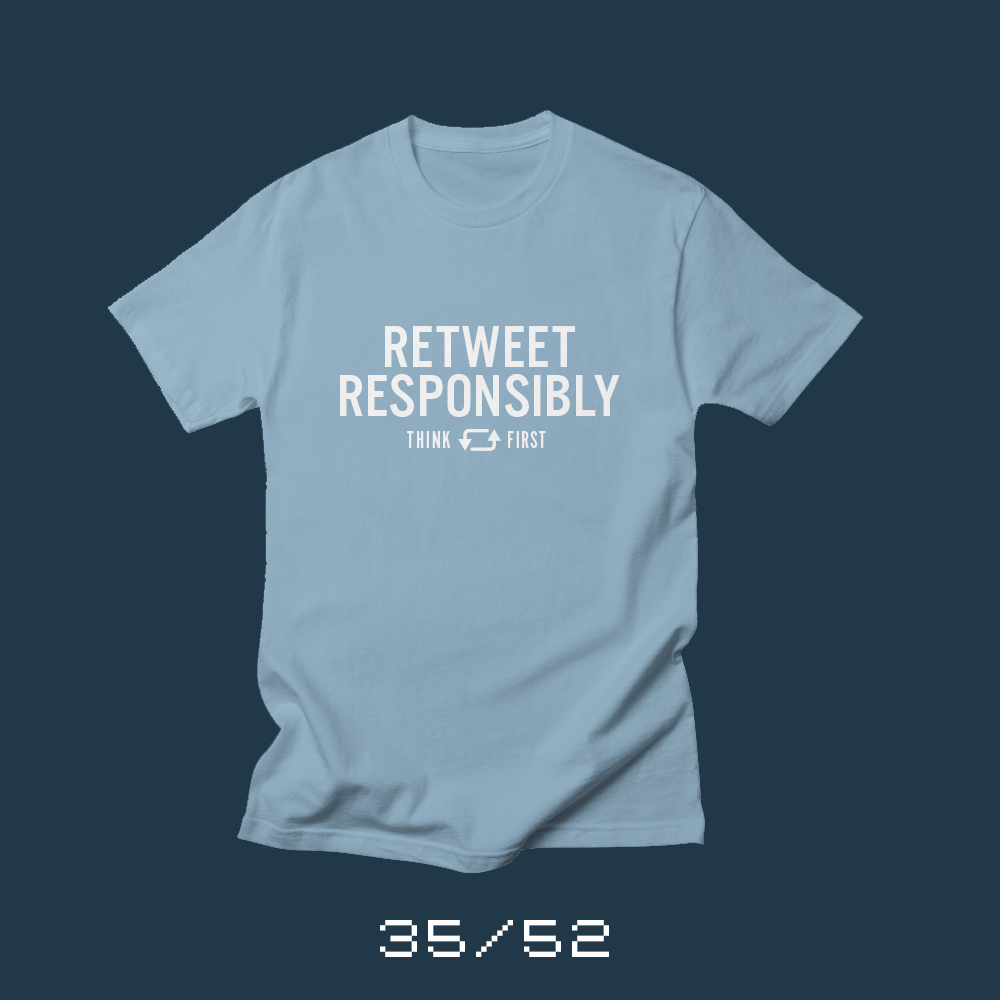
Each week for a year, I’m designing a shirt and releasing it on my Threadless store. This is the design for week 35.
The school shooting in Florida this week was heartbreaking. Heartbreaking because of the loss of life. Heartbreaking because this keeps happening and no one acts to try and prevent it from happening again. Heartbreaking because I send my wife — a teacher — and three kids to school every day and pray that they are never placed in harm’s way.*
In the aftermath of the shooting, social media was … chaos. I know that friends were hurting and angry like I was. They wanted to make a point that something has to change. I get it, and yet, many of them were retweeting things that were false or exaggerated. Bogus stats. Exaggerated claims. Speculation.
Gun advocates were rushing to similarly harshly drawn conclusions. Recommending “solutions” like arming teachers. Tweeting and retweeting false or inflammatory statements — anything they could do to shift the blame towards something other than the American gun culture.
And as if that wasn’t enough chaos, Russian bots jumped into the fray stirring up trouble in their own way.
Here’s the thing, though. When you push false or hastily checked information, your side in the debate suffers. Even if you are mostly right, the minute you stop offering facts and a path forward, you lose credibility.
Retweeting — or sharing on Facebook — information that you don’t know is true, but you want to be true… it does more harm than good. You are as responsible for the things you retweet as the posts your write yourself. When you share something, you personally endorse that you believe it. So spend a few minutes researching before you hit the retweet button.
Twitter and Facebook reward the quick retweet or share.** They are designed to allow you to react with minimal thought. Don’t fall for it. Don’t feed the outrage machine — there’s enough to genuinely be outraged by. Think and help advance the discussion, because something has to change and we have to get there together.
* Heartbreaking because I know the feeling of fear that comes with a lockdown. I’ve been in a active shooter situation twice in the last five years. Once at the University of South Carolina because of a murder-suicide. And once with my entire family at a local mall when there was an apparent shooting.
** I’m beginning to appreciate Manton’s hesitation in introducing reposting to Micro.Blog.
Bob Wertz writes about design, technology and pop culture at Sketchbook B. Bob is a Columbia, South Carolina-based designer, creative director, college instructor, husband and dad. He’s particularly obsessed with typography, the creative process and the tools we use to create. He’s currently in the middle of a project to design a new shirt a week for an entire year.
A year ago, I decided to lessen my reliance on Twitter. Here’s my progress so far…
This post was originally posted on January 3, 2018 on Sketchbook B. It’s reposted here as part of a project to move some of my favorite writing to my new site.
In the last year, the narrative has shifted from Twitter’s possible sale to issues with abuse and hatred. Twitter increased the character count to 280 and that’s worked out fine, but its user growth is still flat. As Twitter tries to jumpstart the service, I still believe the likelihood of Twitter imploding within the next few years is high.
I thought I’d revisit my areas of concern from my previous post and share what I’ve done to mitigate those issues.
I’d lose a bunch of contacts. My first concern was that I’d lose a bunch of contacts that I only had on Twitter. I’m a little less concerned about this than I was a year ago. I’ve slowly started to connect with more people, experts and brands on other services like LinkedIn and Facebook. I’ve still got a ways to go and will continue to expand the roster of people I follow on other services.
I’d change how I watch live events. I’m still using Twitter during live events. For me, this is the hardest to replace. During the Sugar Bowl and the Rose Bowl this week,1 I kept up with commentary from reporters and friends on Twitter. Following commentary on live events is challenging through Facebook. Posts don’t appear in sequential order because of their algorithm.
Twitter is simply the best option to handle streaming written commentary during an event. I’m sure I could use something like Snapchat, but I don’t know enough people on Snapchat for it to be useful for me.2
I’d have to rethink how I find articles and stories. This was a big issue for me, but I’ve kind of solved it… by cheating a little bit. I’ve started using Nuzzel3 to surface headlines from my social media services. Not familiar with Nuzzel? It’s a pretty simple service. You connect your social media services — Twitter, Facebook and LinkedIn — and Nuzzel tells you what links your friends (and friends of your friends) are sharing. This works really well for finding the links and articles that your social circle is talking about… without actually going into Twitter or Facebook. It’s cheating because 95% of the links that come up are from people I follow on Twitter. I really like the service and I see lots of links I would have otherwise missed. I highly recommend it.
I’ve upgraded to Feedly Pro and I’m being more intentional about subscribing to interesting RSS feeds. I’m going to continue to expand my use of Feedly.
I find Facebook useless for finding actual news stories unless I want to know “27 Secrets from The Last Jedi” or some crappy, clickbait slideshow link. And LinkedIn seems equally useless for finding content that I’m interested in.
I need to give Medium another chance, but for some reason, I just haven’t been interested in building an account on Medium with people I follow and read regularly. Maybe that’s something to look into more in 2018.
I’d have to rethink how I share content. Sharing the content I create is another issue. I’m sharing more widely on other services, but I’m still using Twitter. For 2018, I’m shifting most of my short format posting to Micro.Blog with automatic cross posting to Twitter.
And to promote most of my blog posts or interesting content, I schedule posts through Buffer to several different services.
I’ve thought about reposting my blog posts and articles on Medium, but it seems like a lot of work to post everything twice. (And only posting to Medium is not an option for me. I want everything hosted on my site.) I may try Medium again.
I’ve tried and I’ve tried, but I can’t get into Dribbble. I love the concept and I love the community, but it just doesn’t match up with the way I work. Still, the community is great so maybe I’ll give it another shot in 2018.
And finally, Pinterest. For some of my content — specifically my shirt and product designs — Pinterest is a great service. But I haven’t really spent that much time in Pinterest personally, so that might be another avenue I explore in 2018.
I’d change the way I use Facebook. So Facebook… I really do think that we’ve reached the point where you have to have a Facebook account, unfortunately. In today’s communications environment, Facebook is a necessary evil. Over the last year, Facebook has had its own problems with hatred, fake news and discrimination, though, and I’d love to reduce my reliance on Facebook, too.
Facebook is a great place to share family photos, but for serious content, I don’t think it works well. I’ve started to build an audience for the Sketchbook B Facebook page and I’m going to continue to promote the page and hopefully expand the number of followers. That said, I feel like Facebook’s algorithm is going to hide my content unless I pay to promote it, which I may start to do selectively.
I’d spend more time on Instagram. I still love Instagram.4 A couple years ago, I switched my account from a personal account to a business account. The bonus was that I could see viewer metrics, but the drawback was that it would only let me cross post to my Facebook Sketchbook B business page, not my personal profile. Since most of my Instagram shots are family or fun shots, I want to cross post those to my personal Facebook page. I don’t really care about metrics so I recently switched back to the personal account.
I plan to cross post my fun family Instagram images to Twitter and Facebook more regularly. I also plan to manually repost from Instagram to Micro.Blog. It’s a little bit of work, but I like having everything on my site.
I’d try to find a replacement. A little over a year ago, I was guessing that if Twitter disappeared, someone would rise up and meet the needs of its former user base. I didn’t have to wait until Twitter disappeared. A few months after I wrote my post, Manton Reece launched his Micro.Blog Kickstarter project. Micro.Blog is a service that allows me to host my microblog posts — basically, tweets — on my own site and then share through a social media service. Manton’s done a great job so far, and I really think that Micro.Blog is the tip of the iceberg for a resurgence of the independent web. The service isn’t for everyone and it’s in the early days. Manton is still figuring out how some features will work, but I think it’s a great fit for me. (I’m going to write a lot more about Micro.Blog this month, including why I’m excited about it, and detailing how I configured my Squarespace blog to work with Micro.Blog.)
Reality check. I’m not completely giving up on Twitter, though. I’ve been a Twitter user since 2007 and Twitter is part of my daily routine. It’s just a less enjoyable part of my daily routine now. This year, I backed Twitteriffic for Mac on Kickstarter because I wanted my favorite Twitter client on my Mac.
Times are changing, though, and I honestly believe that we all need to be diversifying — and if possible, owning — our social media presence. Becoming less reliant on the big social media behemoths is the first step.
I look forward to revisiting my progress next year.
Bob Wertz is a creative director, type designer, Ph.D. student and researcher living in Columbia, South Carolina. He’s been blogging since 2008.
I joke that I’m a grouchy old guy that doesn’t “get” Snapchat. The truth is that very few of my friends are on Snapchat and so it really isn’t that useful to me. If I had a bunch of friends active on Snapchat, I’d be there. Even if the interface is crap. ↩︎
I tried out Nuzzel based on Jason Snell’s recommendation on one of his many podcasts. ↩︎
This post was originally posted on January 20, 2017 on Sketchbook B. It’s reposted here as part of a project to move some of my favorite writing to my new site.
The Kickstarter has two parts: A book and a service.
The book will detail a framework for independent microblogging… basically a standards-based system for posting and sharing Twitter-like posts.
The service is Micro.blog. And it’s a fascinating attempt to make it as easy as possible to host your own micro blog, basically a decentralized version of Twitter.
I think Manton’s got some great ideas. And I think his heart is in the right place. I love the idea of leveraging RSS for the underpinning of the service. I think 280 characters is great. The iPhone app supports Markdown. You can use your own domain for free or pay $5/month for Micro.blog to host your microblog. An API that others can use to hook into the service. And oh yeah, and the name is perfect.
The Kickstarter project was funded on the first day. And he’s now got a stretch goal — $80,000 — to help fund a community manager to shape the service and actively address the bullying and nastiness that is rampant on Twitter. I don’t know if he’ll make the stretch goal, but I love that he’s already thinking about this.
Also, remember in the early days of Twitter, before they cracked down on the API usage, when third party developers were extending and improving the service. I hope those developers throw everything they’ve got at supporting Micro.blog.
Many people are skeptical that Micro.blog will blossom into a sustainable full featured Twitter replacement. And I completely get that. Look at all the failed attempts to replace or replicate the functionality of Twitter of the years. It’s tough to build a large user base for a new social media site and it’s too early to tell if Micro.blog will take off — after all, the service hasn’t even launched yet. But I think the service and the concept are the right idea at the right time. I’m looking forward to using the service and watching it develop in the coming years.
I’m excited about Micro.blog and about the plan to use RSS to power what is essentially an independent version of Twitter. If you are concerned about the future of Twitter and social networks, I really encourage you to head over to Kickstarter and back the Indie Microblogging project.
Bob Wertz is a creative director, type designer, Ph.D. student and researcher living in Columbia, South Carolina. His blogging journey started in 2008 with a Squarespace hosted blog.
What would happen if Twitter disappeared tomorrow?
This post was originally posted on November 9, 2016 on Sketchbook B. It’s reposted here as part of a project to move some of my favorite writing to my new site.
I’ve been on Twitter since 2007. It’s part of my daily routine and probably my most vital social media channel for finding and sharing news. But Twitter has had some lingering financial issues and when they recently tried to sell the company, no one stepped up to make an appropriate offer.1
Also, a couple of social media experiments have crashed and burned lately. Twitter announced that they were closing Vine.2 Talkshow had a bunch of potential but didn’t make it six months. And while Twitter is much larger, it’s not immune from financial reality.
Which got me thinking, what if we woke up one morning and Twitter was gone. Or more likely, what if Twitter changed so radically, that it was unusable? How would that change the way I get things done?
I’d lose a bunch of contacts. I follow a large number of designers, brands and local experts on Twitter — and no where else. If Twitter disappeared, I’d lose all those contacts and have to try and reconstruct the network on another channel. Not an easy task.
I’d change how I watch live events. During the World Series, I kept an eye on Twitter. During the presidential debates, I followed along on Twitter. During the University of South Carolina’s football game last weekend, I kept up with the score on Twitter. During election night coverage, sigh. Twitter is the perfect companion to a live event and I’d miss seeing what my friends and family think in real time.
I’d have to rethink how I find articles and stories. I find lots of inspirational links and content on Twitter. If Twitter goes away, I’m using RSS and Feedly much more aggressively.
I’d have to rethink how I share content. I share most of my blog posts through Twitter. If Twitter were gone, I’d have to share them somewhere else like Facebook or Medium.
I’d change the way I use Facebook. I use Facebook for family pictures and connecting with people I know and have met. If Twitter disappeared, I’d probably use Facebook more to connect with a wider audience. Maybe I’d invest more time into building the Sketchbook B page on Facebook. Post more links to articles on my Facebook feed. If Twitter goes away, my Facebook experience changes radically.
I’d spend more time on Instagram. Because I love Instagram, almost as much as I love Twitter. And I’m going to have some free time if there is no Twitter.
I’d try to find a replacement. If Twitter disappeared, I imagine several companies would rush to unveil a replacement. Or modify their social product to attract Twitter refugees. You know Google would retool and rebrand Google Plus, Linked In might try to be less of a train wreck. Even Snapchat might try to appeal to former Twitter users. Startups would start, and fail. Someone would try to resurrect App.net. I’d try them all, but I’m not sure there can truly be a replacement for Twitter.
But… reality.
So I don’t think Twitter will just shut down. At some point, the price to purchase the company gets so low, that someone will take a chance on them. I’m more concerned that Twitter, or a company that buys Twitter, will change it so completely, that it becomes useless.
This exercise had forced me, though, to start evaluating areas where I am too reliant on Twitter. I’m going to start connecting to designers and thought leaders on other channels. I’m looking for new avenues to find and share content. I’ll evaluate how I use channels like Facebook, Instagram, Dribbble, YouTube and Medium.
Twitter might not disappear, but it’s still best not to keep your eggs in one basket.
Bob Wertz is a creative director, type designer, Ph.D. student and researcher living in Columbia, South Carolina. He’s been blogging since 2008.
This was compounded by the fact that few established companies — like Disney — wanted to take on Twitter while abusive rhetoric is rampant. Let’s face it, Twitter has been a dumpster fire during this election season. ↩︎
This post was originally posted on October 31, 2016 on Sketchbook B. It’s reposted here as part of a project to move some of my favorite writing to my new site.
95 reasons to reform the church! (#15 changes everything!)
Almost 500 years ago today, Martin Luther nailed his 95 Theses to the door of a church in Wittenburg in Germany. This act, intended to provoke discussion and debate, sparked the Reformation and fragmented the Christian church.
Over the next few decades, Luther spread his message through a variety of methods, taking advantage of the latest technology, the printing press. He wrote letters, books and sermons. He translated the bible into German to better reach his target audience. He created devotional materials for families. He composed hymns to reach the masses. He gathered his followers together to have discussions which they then shared with other Protestant reformers. His message of reform spread through Europe, inspired followers and provoked discussion.
Martin Luther was the first content strategist.
It’s not hard to imagine Luther using today’s technology to spread his carefully crafted content. Tweeting to his followers.* Retweeting fellow reformers. People live tweeting his sermons. Blogging on the latest topics. Sharing posts on Facebook — “95 reasons to reform the church! #15 changes everything!” Putting music and videos on YouTube. Authoring free ebooks. Sending email newsletters. Podcasting.
Martin Luther used content to change the world — almost five centuries before the creation of the internet. And his lasting impact, 499 years later, is a testament to the power and longevity of powerful and effective messaging.
* I can imagine Martin Luther complaining about how hard it is to get verified on Twitter.
Bob Wertz writes about design, technology and pop culture. Bob is a Columbia, South Carolina-based designer, creative director, college instructor, husband and dad. He’s particularly obsessed with typography, the creative process and the tools we use to create. In his spare time, he geeks out about all things historical.
This post was originally posted on November 12, 2009 on Sketchbook B. It’s reposted here as part of a project to move some of my favorite writing to my new site.
I went to Subway last week. I don’t typically eat at Subway, but there is one by my office and I didn’t have much time for lunch. As I walked in, on the door, there was a window cling encouraging me to order soup with a combo. When I got in line, I looked up and there on the menu was an ad encouraging me to order soup. At the register there was another sign.
So I ordered soup.
I grabbed a seat. And realized I didn’t have a spoon. I looked up by the straws and napkins. There were forks and knives, but no spoons. So I asked the woman behind the counter – the same woman who sold me the soup – if they had any spoons. After asking another employee, she confirmed that they had no spoons in the restaurant.
The big picture
It seems both silly and odd that a franchisee would go to all the trouble of putting up all the signs and ads and then mess up something as simple as having spoons.
But I think this type of thing is very common in business. Often, we see people obsess over seemingly insignificant details, only to completely overlook a major issue. They work on the details and lose sight of the big picture.
As designers, we see this a lot.
Clients spend time and energy critiquing minor elements of a design, but often forget to shore up the logistical issues that support a campaign. Marketing and design are critical, but so is customer service and support. Think about my Subway story for a second. The marketing worked. I entered the store. And I purchased soup. However because of a minor – but critical – oversight, I was a dissatisfied customer.
Social media and a lack of spoons
Right now, social media is all the rage. Everyone seems to be talking about how social media can help their business. Worrying that they’ll be left behind if they aren’t on Twitter or Facebook. Consultants are aggressively selling social media services.
But I fear many of these folks are losing sight of the big picture. Social media is a tactic. And yes, it can be an effective and powerful tactic. But as companies develop their social media plans, they cannot forget that it is just the beginning of the customer relationship. Strategically, you need to think through the entire customer experience. What are you going to do with your customers after you reach out to them through social media? How do you want to engage your customers on a continuing basis?
I’m not saying social media is bad or that it isn’t important. There are absolutely uses for social media in business and marketing. Just remember that the social media tactics are only the beginning. You and your company need to prepare for a long-term customer relationship.
Or in other words, when you decide to sell soup, make sure you are ready to provide spoons.
Bob Wertz is a creative director, type designer, Ph.D. student and researcher living in Columbia, South Carolina. He’s been blogging since 2008.